



The Best Intellectual Clubs in London: Where Ideas and People Meet
A guide to London’s intellectual clubs, from historic Pall Mall institutions to contemporary communities built around dialogue, culture, and personal development.
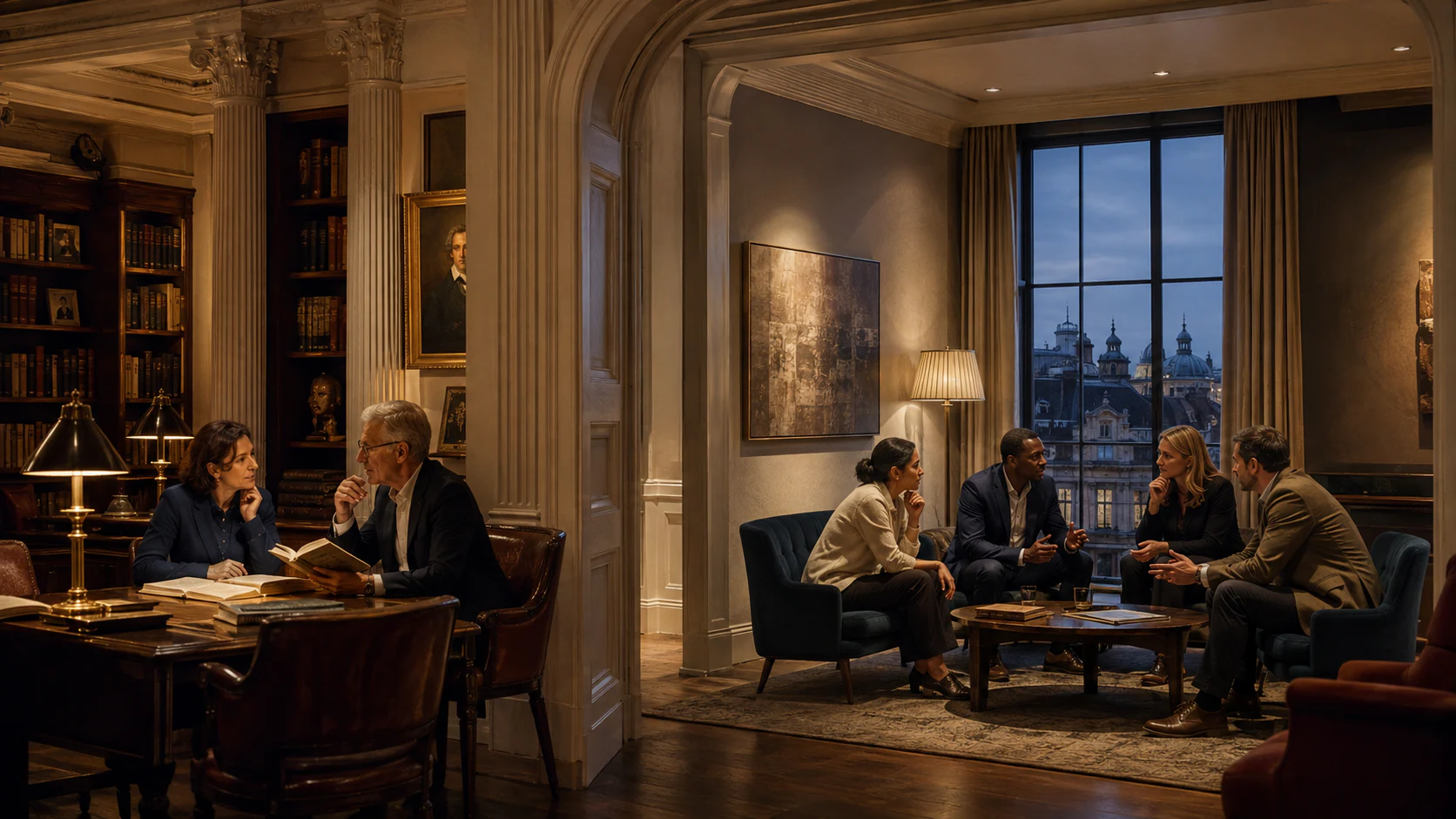
Top intellectual clubs in London for curious minds
London has always been a city that thinks. Long before the lecture hall or the conference centre, it was the coffee house that served as the engine of British intellectual life: those smoky, democratic rooms where merchants argued with philosophers, poets debated scientists, and the ideas that would reshape a civilisation were aired without ceremony. That tradition did not disappear. It deepened, diversified, and found new forms, from the learned societies of the Victorian era to the literary salons of the twentieth century. Today, for the professional who craves genuine depth rather than the transactional pleasantries of conventional networking, the top intellectual clubs in London represent some of the most rewarding communities a curious mind can enter.
Clubs such as Helios Intellectual Club, established in 2025 and based in London, demonstrate what this tradition becomes when reimagined for the twenty-first century: a private members' community built not around passive consumption of ideas, but around the living dialogue that transforms knowledge into wisdom. This guide exists to help you find your way through what follows. Whether you are drawn by centuries of scholarly prestige or by the electricity of a contemporary intellectual community, what follows will help you evaluate London's finest options by membership culture, programming depth, and the quality of the community you would be joining.
What sets a true intellectual members' club apart
Not every members' club is an intellectual one, and the distinction matters enormously. The markers of genuine intellectual culture in a club are specific: the quality and ambition of its programming, and the degree to which the culture encourages genuine exchange rather than the polite performance of connection. The calibre and diversity of fellow members matters too, though this is harder to assess from the outside. A dining room full of accomplished people who never challenge one another is not an intellectual community. It is merely an expensive restaurant.
London's intellectual clubs span a remarkable spectrum, from ancient institutions built on formal sponsorship and white-tie ceremony to newer formations built explicitly around ideas and experiential learning. Neither age nor prestige alone signals intellectual vitality. Some notable intellectual clubs in London have been founded within the last decade, whilst some of the city's oldest institutions continue as forces for serious discourse, evidence that the tradition remains alive across very different forms.
The difference between heritage and contemporary models
The traditional model, exemplified by clubs founded in the nineteenth century, tends to emphasise formal admission processes, historical gravitas, and a lecture-based programme where distinguished speakers address audiences of members. The contemporary model inverts this: it places dialogue at the centre, treats members as co-creators of the intellectual experience, and prioritises developmental depth over passive attendance. Neither model is inherently superior, but they serve different needs. Understanding which model resonates with your own intellectual temperament is the first step in making a wise choice.
How to evaluate a club before you commit
Before applying anywhere, it is worth examining the programming calendar honestly: does it reflect genuine intellectual ambition, or is it a series of pleasant talks that could equally have been a podcast? Equally important is the member community profile, who are these people, and would their company challenge you? Beyond that, the practical realities of fees, sponsorship requirements, and waiting times will shape not just whether you can join, but whether membership will remain sustainable as part of your life over the longer term.
Top intellectual clubs in London, heritage and modern establishments
To speak of London's intellectual clubs without acknowledging the canonical heritage establishments would be an act of wilful amnesia. These institutions shaped the city's intellectual culture across two centuries, and their legacy deserves genuine reverence, alongside honest assessment of what they offer the contemporary seeker.
The Athenaeum: scholarship and quiet prestige
The Athenaeum remains the archetypal thinkers' club among London's private members' establishments. Capped at 2,000 members, it requires both a proposer and a seconder who are existing members, making it a club one enters through reputation rather than application alone. Annual fees for London members aged 35 and over sit at approximately £1,781, with the first year carrying an additional joining fee. The atmosphere is one of scholarly formality: collared shirts and jackets are expected, ties until seven in the evening, and the culture reflects an institution that has never needed to raise its voice to assert its standing. The Athenaeum is ideal for senior academics, established public figures, and those for whom heritage and gravitas are themselves a form of intellectual nourishment.
The Reform Club and the Arts Club: politics, culture and ideas
The Reform Club carries a proud tradition of liberal intellectual discourse, with an entrance fee of approximately £1,500 and annual membership understood to sit between £1,676 and £1,821, based on 2024, 25 members' club estimates; the club does not publish current fees officially, so prospective members should contact them directly for confirmed figures. The club does not publish a formal waiting-list duration, though applicants should expect the process to take time. The Arts Club, founded for those engaged with arts, literature, or sciences, once counted Charles Dickens among its luminaries and continues to host cultural events and exhibitions for a membership with a distinctly creative character. Both clubs are worth contacting directly to understand current membership availability and process, as neither publishes exhaustive details publicly.
Literary and cultural clubs in London for the book-minded
For those whose intellectual life is rooted primarily in literature and reading, London offers options that sit slightly outside the traditional private members' club structure but deserve equal consideration as part of any guide to cultural clubs in London.
The London Library: a membership worth considering
The London Library occupies a category of its own. It is not, strictly speaking, a social club, but a working community of writers, researchers, and intellectuals built around one of the world's great private research libraries in St James's Square. Membership provides access to a vast collection of physical and digital resources, a programme of events and talks, and a community of serious readers who treat the written word as a vocation rather than a leisure activity. The London Library's membership process is generally more open than many private members' clubs; prospective members should consult the Library's official membership pages for current entry requirements and any sponsorship conditions.
Discussion salons and reading circles in London
Beyond the formal institutions, London sustains a rich ecosystem of smaller, less formal intellectual gatherings: philosophical discussion groups, literary salons, and curated reading circles that meet regularly and often welcome curious newcomers. These offer lower financial barriers and a more experimental culture, and they can serve as a genuine introduction to intellectual community life. Their limitations are real, however. Consistency of quality varies, the community tends to be more diffuse, and the depth of connection between members rarely matches what a structured membership community provides over time.
London debating clubs and modern venues redefining membership
The past decade has produced a generation of London members' clubs that position themselves explicitly around ideas, activism, and intellectual discourse rather than tradition. They deserve serious consideration, alongside honest assessment of what they do and do not offer.
The Conduit: where ideas meet social responsibility
The Conduit runs more than 150 events annually across conferences, panels, workshops, debates, and film screenings, a figure drawn from its own events programme. Its ethos centres on connecting socially conscious professionals, and its programming includes open days for prospective members and live-streamed key events for broader audiences. The Conduit is genuinely strong on events, and for those whose intellectual interests orbit sustainability, social impact, and progressive discourse, it represents a compelling community. Its identity is, however, notably focused on those specific themes rather than the full breadth of intellectual development; it is a club with a cause, which is both its strength and its natural limitation.
What the new wave of clubs offers, and where it falls short
The contemporary generation of intellectual clubs generally offers lower barriers to entry, more diverse membership, and a dynamic events calendar. What many of them share, however, is a fundamentally passive model: members attend events, hear speakers, and depart enriched but unchanged in any structural sense. The experience remains largely consumptive. The question worth asking is whether attending stimulating talks constitutes an intellectual community, or whether it is something closer to a well-curated schedule of evening entertainment. The distinction is significant for anyone seeking genuine transformation rather than pleasant stimulation.
Helios Intellectual Club: a next-generation model for serious thinkers
Helios Intellectual Club, established in 2025 and based in London, occupies a position that is genuinely distinct from every other community described in this guide. It does not position itself as a competitor to the Athenaeum's heritage or The Conduit's social mission. It is something different in kind: a private members' club that treats knowledge not as content to be consumed, but as something to be lived, debated, and co-created through genuine dialogue between people who take ideas seriously.
Dimensions of intelligence and why that matters
According to its own membership literature, Helios is built around the development of several dimensions of intelligence, cognitive, emotional, social, creative, and spiritual, amongst others. This is not a philosophical flourish. It is, the club says, the structural logic of how it designs its programming and its community. Where most clubs focus on a single register, whether academic lectures or business discourse, Helios asks what it would mean to develop a human being in full, across the dimensions of mind, relationship, imagination, and inner life. Members are not simply exposed to ideas; they are, by the club's account, actively developing as thinkers, leaders, and individuals in ways intended to accumulate into something genuinely transformative.
Membership culture, dialogue sessions and the speaker programme
The centrepiece of Helios's programming is its curated in-person dialogue sessions, which replace the traditional lecture format with collaborative intellectual discourse. These are not panel discussions with polite audience questions; they are structured conversations in which members are active participants rather than passive recipients. The speaker programme invites thought leaders to participate not as lecturers but as what the club describes as "architects of meaning", people who come to spark genuine thinking in those they encounter. The club says it aims to attract a cosmopolitan and multilingual membership spanning intellectuals, entrepreneurs, creatives, and cultural figures, with a bridging of Russian intellectual tradition and London's global influence among its distinguishing characteristics. Those interested in membership are invited to make an enquiry directly through Helios's membership process to learn about the current community, the application experience, and whether the fit is right.
How to choose the right club and take your first step
The right intellectual home is not necessarily the most prestigious one, nor the most accessible. It is the one whose community will genuinely challenge you, whose programming will develop capacities you do not yet possess, and whose culture will make you feel that the world is more interesting for having spent time within it.
Matching your priorities to the right community
If prestige and heritage are your primary criteria, the Athenaeum and the Reform Club both merit serious consideration, provided you have the patience for their processes and the existing connections to initiate them. If literary immersion is what you seek, the London Library is irreplaceable in its specific domain. And if you want a living intellectual community that actively challenges and develops you as a thinker across multiple dimensions, Helios makes a purposeful case, built, by its own description, for people who are not yet finished becoming who they intend to be. As with any club, the best way to assess the fit is to attend an event and meet the people already in the room.
Practical steps for enquiring, visiting or applying to top intellectual clubs in London
Heritage clubs require patience and an existing member connection; begin by establishing those relationships well before you need them. Modern clubs such as The Conduit typically offer open days, which are worth attending before committing to membership. For Helios, the invitation is direct: reach out through the club's membership enquiry process, speak to someone who can help you understand whether the community is the right fit, and, if possible, attend an event before making your decision. Across all of London's top intellectual clubs, the same principle holds: trust your instinct about the people you meet. The quality of a community is, in the end, the quality of the individuals who sustain it, and the conversations you find yourself having on the way home are usually the clearest measure of whether you have found the right room.