



Art Lover’s Guide to London: 4 Museums and the Masterpieces You Shouldn’t Miss. Helios Intellectual Guide
London is one of the world’s leading centres of art, where ancient antiquities, Old Master paintings, Impressionism, and contemporary design exist side by side. This Helios Intellectual Guide will help you choose the museums worth visiting, understand their history, architecture, and key masterpieces, and discover what sets the British Museum, the National Gallery, the Victoria and Albert Museum, the Wallace Collection, the Courtauld Gallery, and other institutions apart. Rather than a typical tourist checklist, it is a guide for those who want to experience art with greater understanding and curiosity.
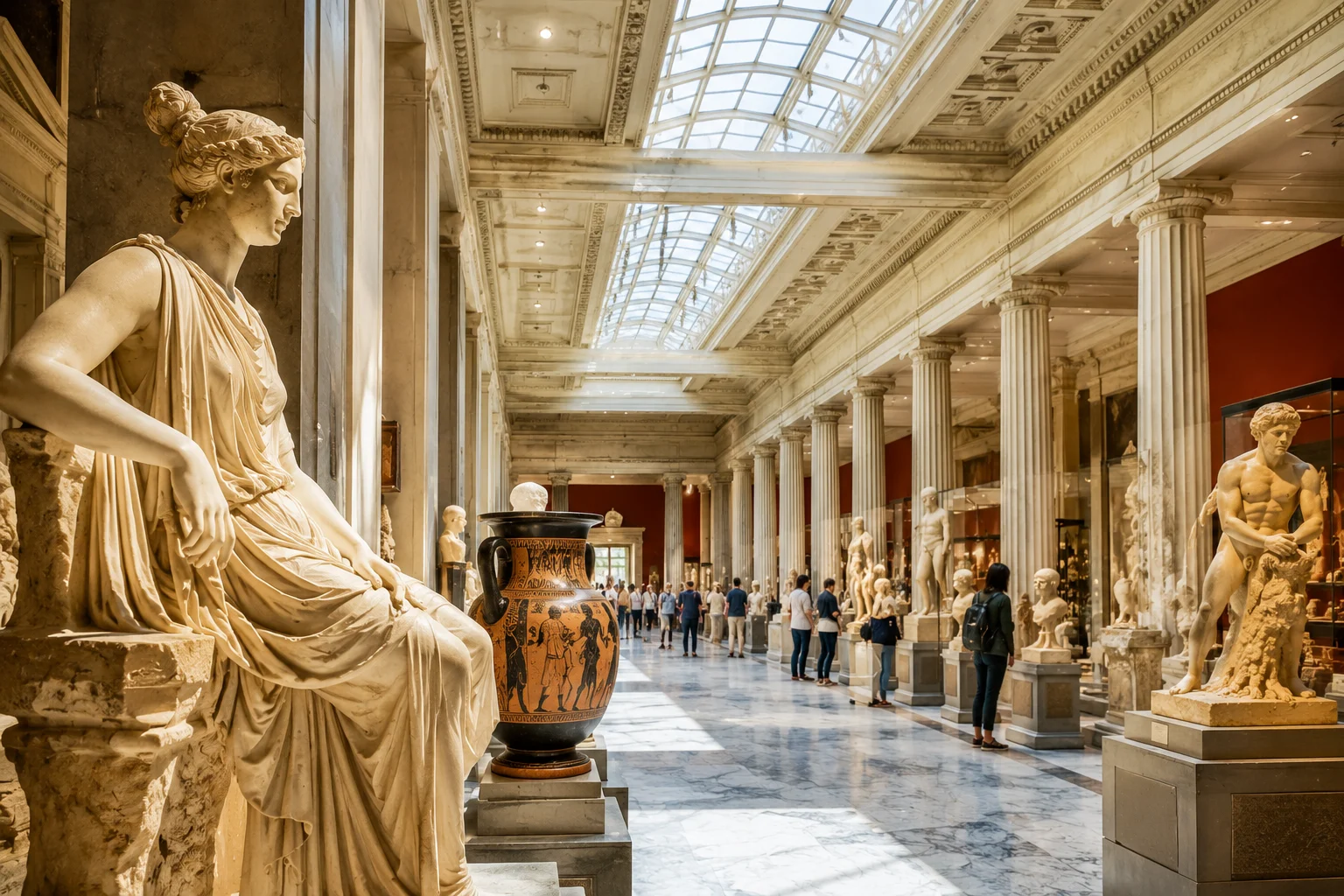
Why London Is One of the World’s Greatest Cities for Art
Most visitors come to London for Big Ben, Buckingham Palace, or Tower Bridge. They tick off the city’s famous landmarks, take their photographs, and leave a few days later believing they have experienced the British capital.
Yet the real London begins somewhere else.
It reveals itself in museum galleries, where ancient marbles stand beside the paintings of Rembrandt, where Victorian collectors continue a dialogue with contemporary artists across the centuries, and where the history of Europe is told not through words, but through objects shaped by human hands.
London is one of the few cities in the world where it is possible to travel from Ancient Egypt to British Modernism in the space of a few days. Its museums hold the treasures of Mesopotamia, masterpieces of the Italian Renaissance, outstanding collections of British painting, works by the French Impressionists, classical sculpture, Japanese ceramics, Islamic art, and decorative objects from nearly every major civilisation.
This guide, however, is not a ranking of London’s most popular museums. Popularity does not always equate to cultural significance. Some of the city’s greatest institutions welcome millions of visitors each year, while others remain surprisingly overlooked—even by many Londoners. Yet it is often these smaller collections that offer the most rewarding encounters with art, allowing visitors to engage with works more thoughtfully than in the vast halls of the largest museums.
This guide is written for those who want to do more than simply admire great paintings. It is for readers who want to understand why these works transformed the history of European art and continue to shape the way we see the world.
Rather than following the familiar ambition to “see everything,” we propose a different approach: to learn how to look. Perhaps that is the museum’s greatest purpose. A museum does more than preserve the past—it teaches us how to pay attention.
British Museum
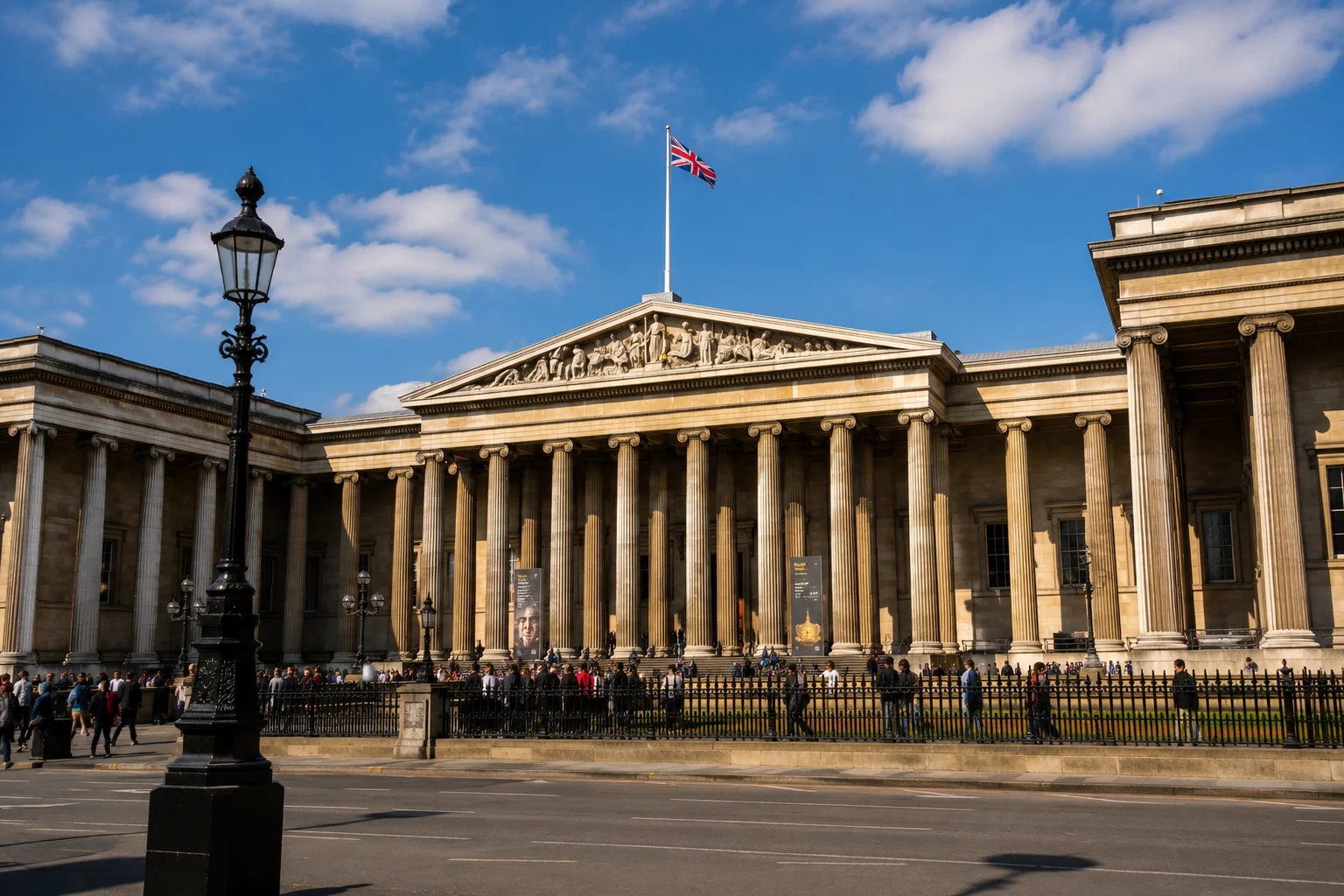
The British Museum
🌐 https://www.britishmuseum.org
Great Russell Street, London WC1B 3DG, United Kingdom
If there were a single museum capable of telling the story of human civilisation without the need for a single book, it would be the British Museum. Founded in 1753 on the collection of the physician and naturalist Sir Hans Sloane, it became the world’s first national public museum. The idea itself was revolutionary. In the eighteenth century, knowledge was beginning to move beyond the exclusive domain of the aristocracy and become accessible to the wider public.
The British Museum was never intended to be merely an art museum. Its ambition was far greater: to tell the story of humanity through material culture. That is why Assyrian palace sculptures stand alongside Greek marbles, Egyptian sarcophagi, Chinese porcelain, Aztec artefacts, and medieval manuscripts. Every object forms part of a much larger narrative about the development of civilisation.
Admission: Entry to the permanent collection is free. Although advance booking is not required, reserving a free timed-entry ticket is recommended, as it provides priority access during busy periods. Special exhibitions require a separate paid ticket.
Architecture
The museum’s main building is designed in the Greek Revival style. Its monumental colonnaded façade evokes an ancient temple, reinforcing the idea of the museum as a modern temple of knowledge.
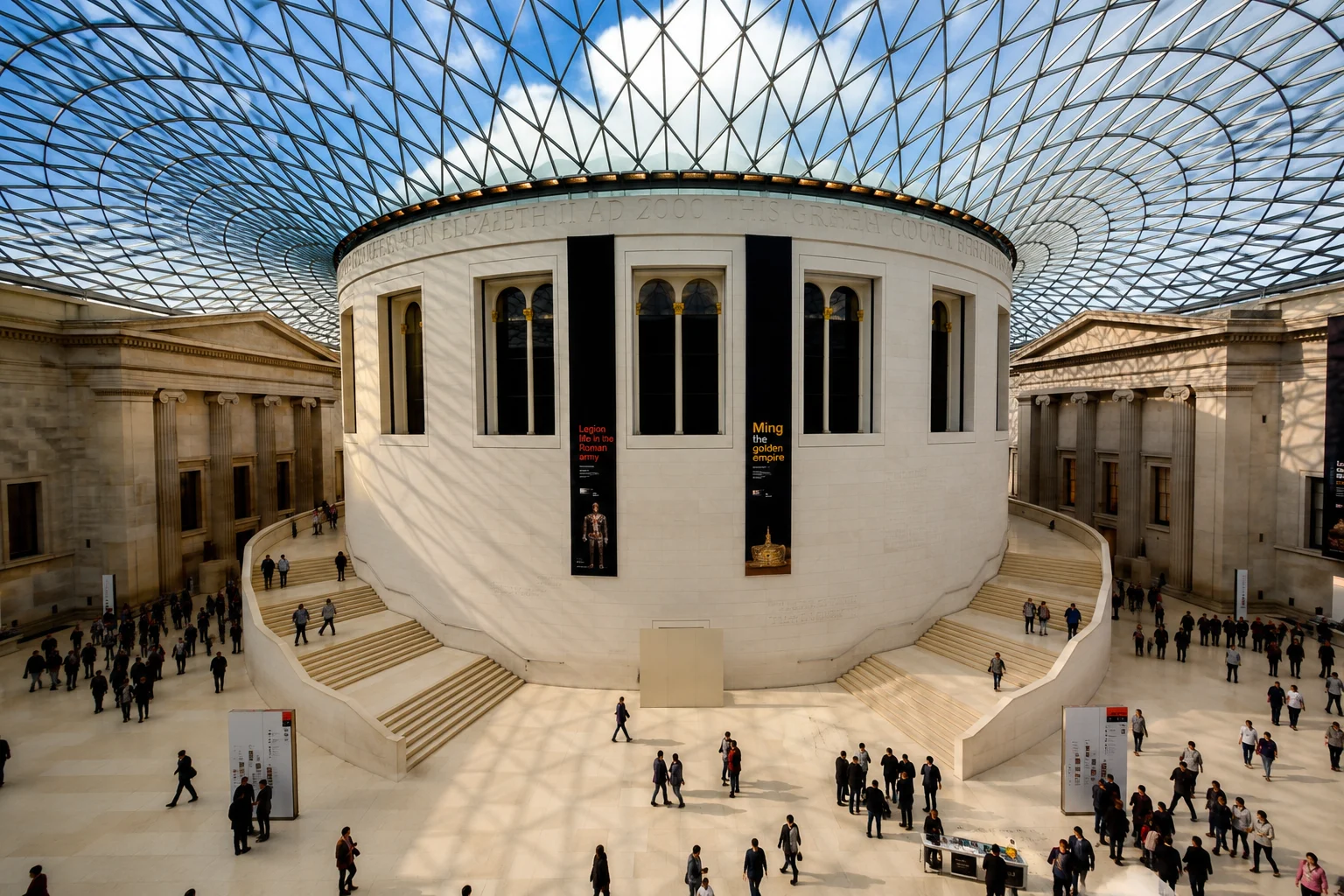
One of its architectural highlights is the Great Court, redesigned by Sir Norman Foster. Covered by a spectacular glass roof, the former inner courtyard has been transformed into one of Europe’s most remarkable public spaces.
Here, the dialogue between the nineteenth and twenty-first centuries is especially evident.
Rather than competing with the historic building, the contemporary intervention complements it, creating a thoughtful conversation between heritage and modern design.
What You Shouldn’t Miss
If this is your first visit, don’t try to see everything. Even several days are not enough to explore the entire museum.
Instead, focus on a handful of extraordinary objects—each of which has fundamentally changed our understanding of history.
The Rosetta Stone
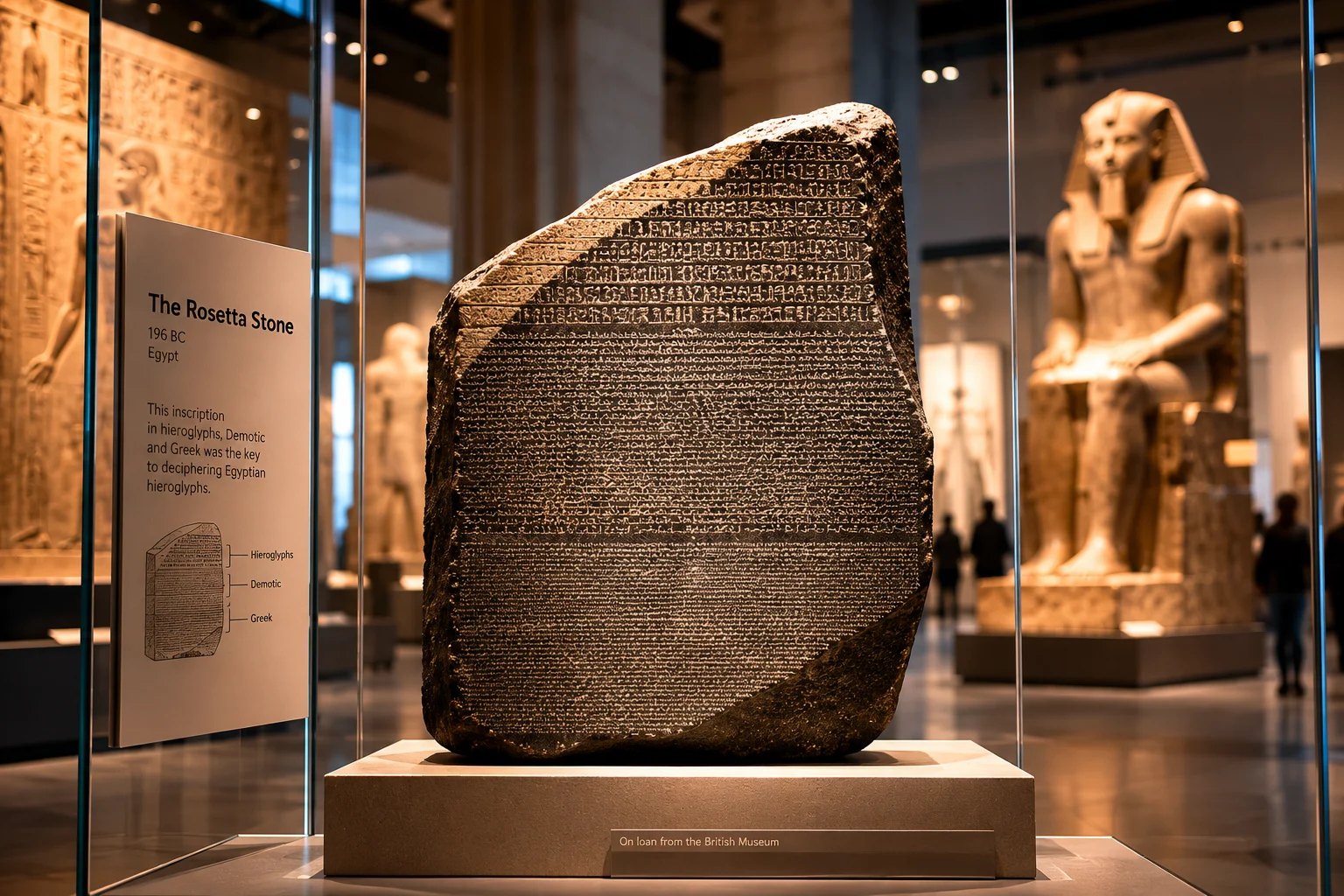
Thanks to the Rosetta Stone, Jean-François Champollion was able to decipher ancient Egyptian hieroglyphs. The stone bears the same decree inscribed in three scripts: Egyptian hieroglyphs, Demotic, and Ancient Greek. Because Ancient Greek was already well understood, scholars were able to compare the texts and gradually unlock the meaning of the Egyptian script.
This breakthrough transformed the study of ancient Egypt. For the first time, researchers could read inscriptions, official documents, and religious texts that had remained undeciphered for nearly fifteen centuries. The Rosetta Stone became the key to understanding the history, culture, religion, and everyday life of one of the greatest civilisations of the ancient world.
The Parthenon Sculptures
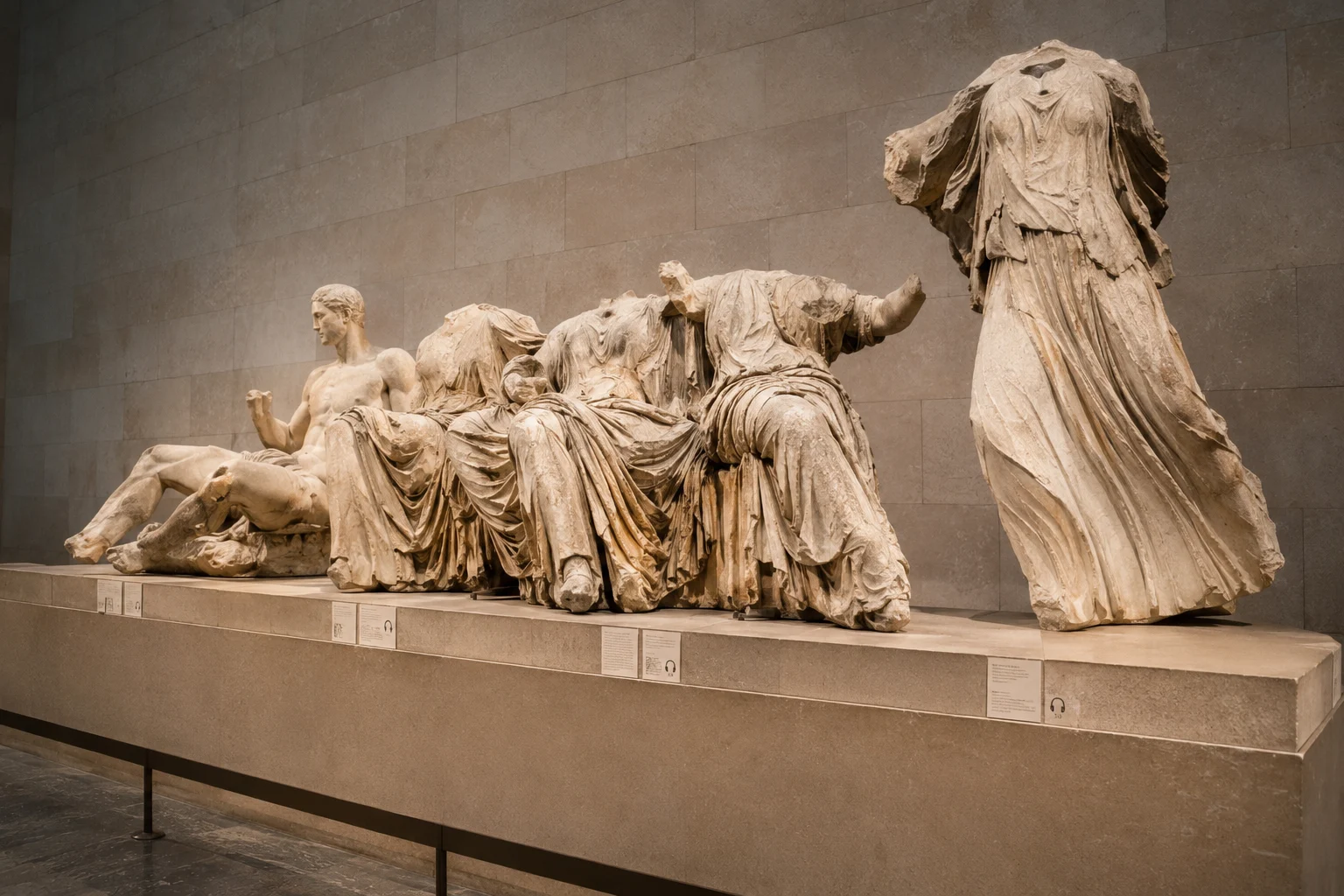
The Parthenon Sculptures
Also known as the Elgin Marbles, they remain at the centre of an international debate over cultural heritage, restitution, and the role of universal museums.
Created in the fifth century BC to decorate the Parthenon on the Acropolis of Athens, the sculptures are among the greatest surviving masterpieces of Classical Greek art. In the early nineteenth century, the British diplomat Lord Elgin removed a substantial portion of the sculptures from Ottoman-ruled Greece. They were later brought to Britain and eventually acquired by the British Museum.
Today, Greece argues that the sculptures are an inseparable part of its cultural heritage and should be returned to Athens. The British Museum maintains that they were acquired lawfully and that their display in London allows a global audience to engage with them in the broader context of world history. The debate has become one of the most significant and enduring discussions surrounding the ownership, stewardship, and repatriation of cultural heritage.
Assyrian Winged Bulls (Lamassu)
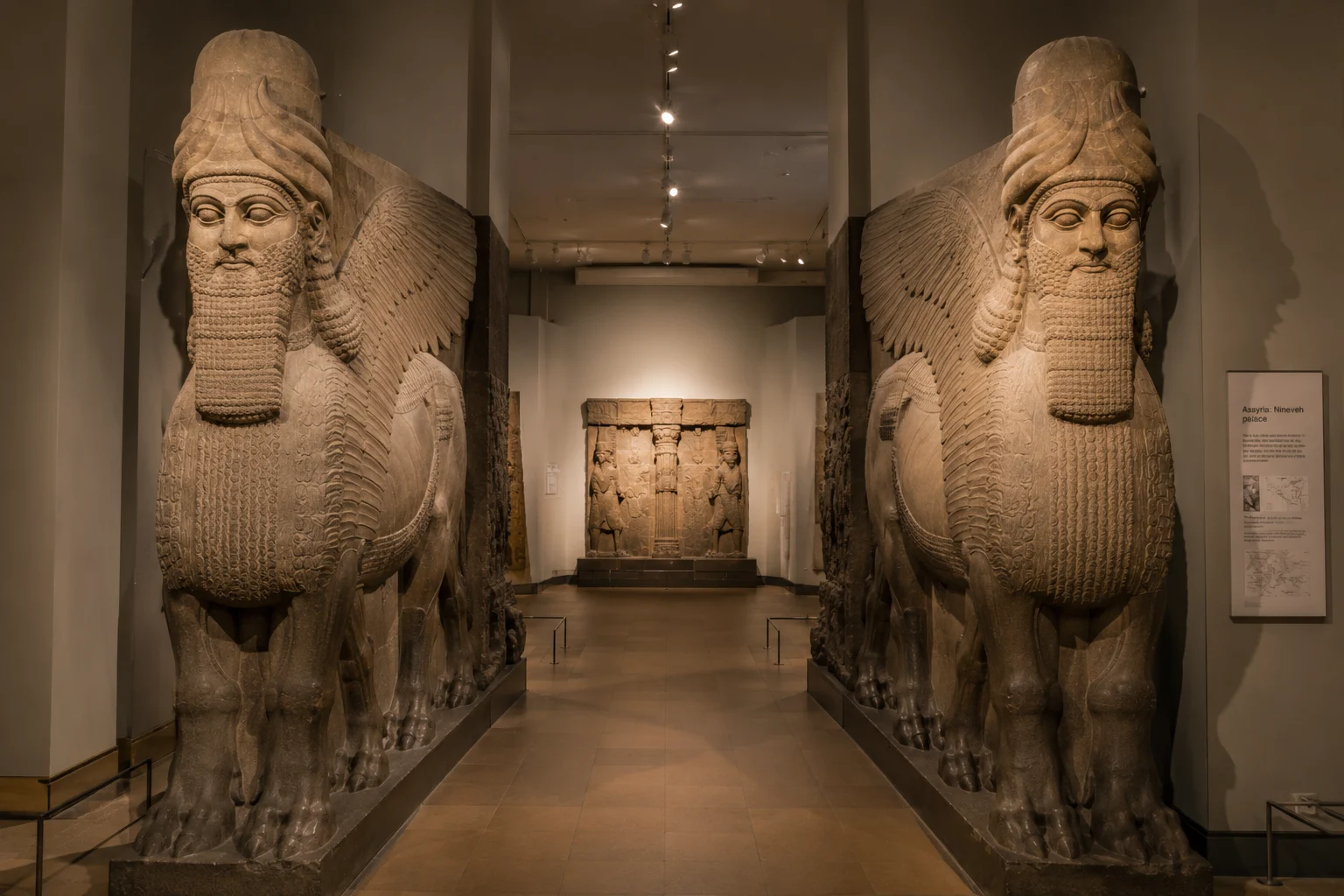
These monumental guardians of the royal palaces of Nineveh impress not only with their scale but also with the way the ancient Assyrians imagined power and protection. Combining the body of a bull or lion, the wings of an eagle, and the head of a human, the Lamassu symbolised strength, wisdom, and divine guardianship, standing watch over the entrances to royal palaces.
Their homeland—modern-day Iraq—has endured decades of war and destruction. In 2015, ISIS militants deliberately destroyed several ancient Lamassu in the archaeological site of Nimrud, denouncing them as “pagan idols.” The attack shocked the world and became a powerful symbol of the irreversible loss of cultural heritage. Because many Assyrian monuments had been excavated and transferred to European museums during the nineteenth century, a number of original Lamassu survived. Today, those preserved in the British Museum remain among the most important witnesses to the achievements of one of the world’s earliest great civilisations.
The Lewis Chessmen
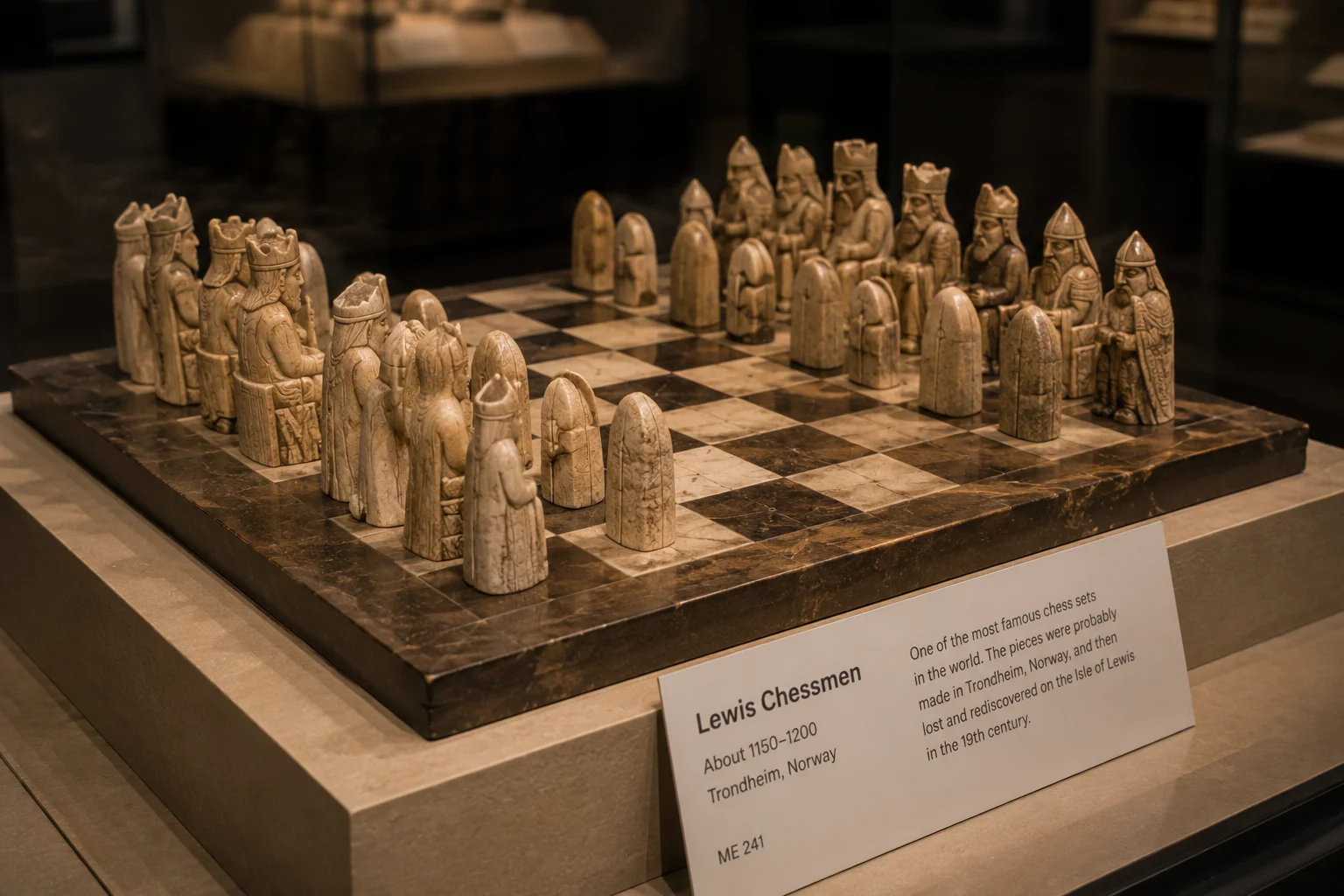
One of the world’s most celebrated medieval chess sets, offering a remarkable glimpse into life in Northern Europe nearly nine centuries ago.
The pieces were carved in the twelfth century, most likely in Norway, from walrus ivory and whale tooth. They were discovered in 1831 on the Isle of Lewis in Scotland’s Outer Hebrides. To this day, no one knows exactly why such a valuable collection was buried there—perhaps it was lost or deliberately hidden by a medieval merchant.
Today, the Lewis Chessmen are regarded as masterpieces of medieval art. Their expressive kings, queens, bishops, and the famous berserkers biting their shields have become iconic images of the Middle Ages. Beyond their importance to the history of chess, the figures provide valuable insight into the clothing, warfare, craftsmanship, and concepts of power in twelfth-century Northern Europe.
The Standard of Ur
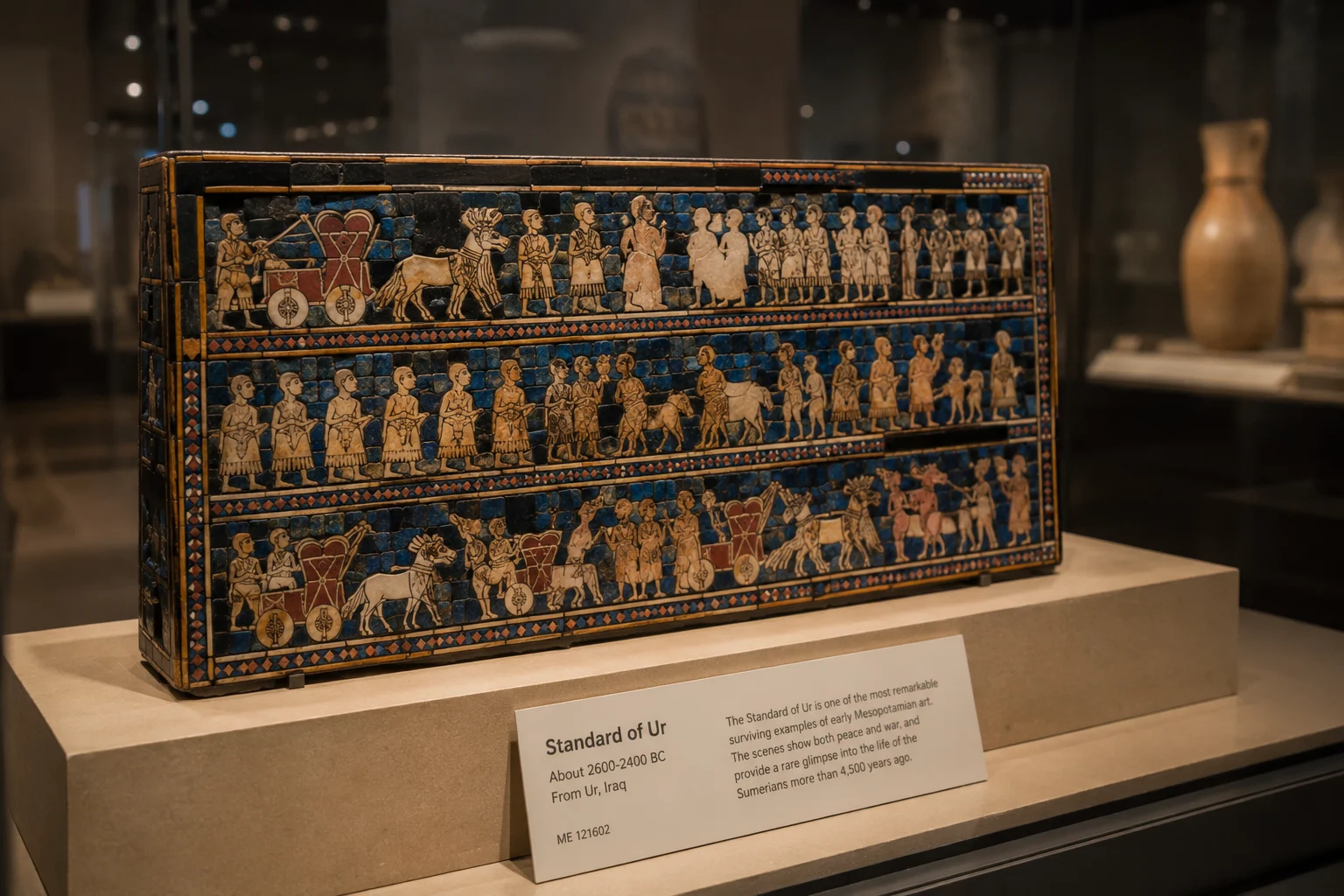
A remarkably small object that offers an extraordinary glimpse into the world of the Sumerians nearly five thousand years ago.
Despite its name, scholars are still uncertain about its original function. It may have served as a musical instrument, a ceremonial standard, or a decorative element. Its wooden panels are inlaid with mosaics of lapis lazuli, shell, and red limestone, depicting scenes of both war and peace.
These intricate images have made the Standard of Ur one of the most important sources of knowledge about Sumerian civilisation. They portray warriors, chariots, banquets, craftsmen, and a ruler, providing a vivid picture of the social structure and daily life of one of the world’s earliest city-states.
Ancient Egyptian Mummies
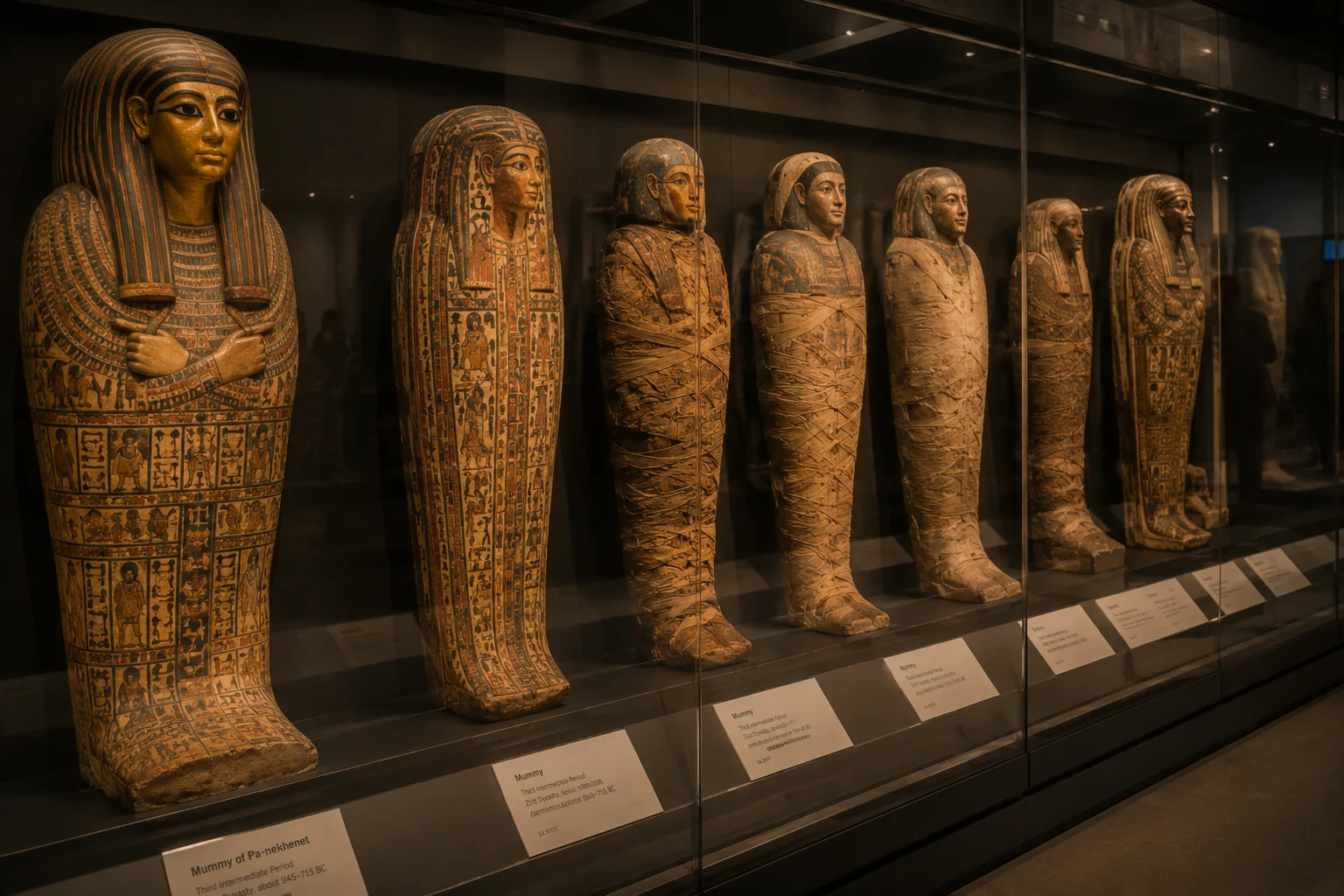
They tell us less about death than about the ancient Egyptians’ beliefs in immortality.
The British Museum houses one of the world’s largest collections of Egyptian mummies and sarcophagi. Alongside human remains, visitors can see mummified sacred animals as well as the objects that accompanied the dead into the afterlife, including amulets, funerary masks, and beautifully painted coffins.
Together, these artefacts trace the evolution of Egyptian funerary traditions over thousands of years. Thanks to modern research techniques such as CT scanning, scholars can now study mummies without unwrapping them, revealing the age, health, lifestyle, and even the causes of death of people who lived several millennia ago.
Sutton Hoo
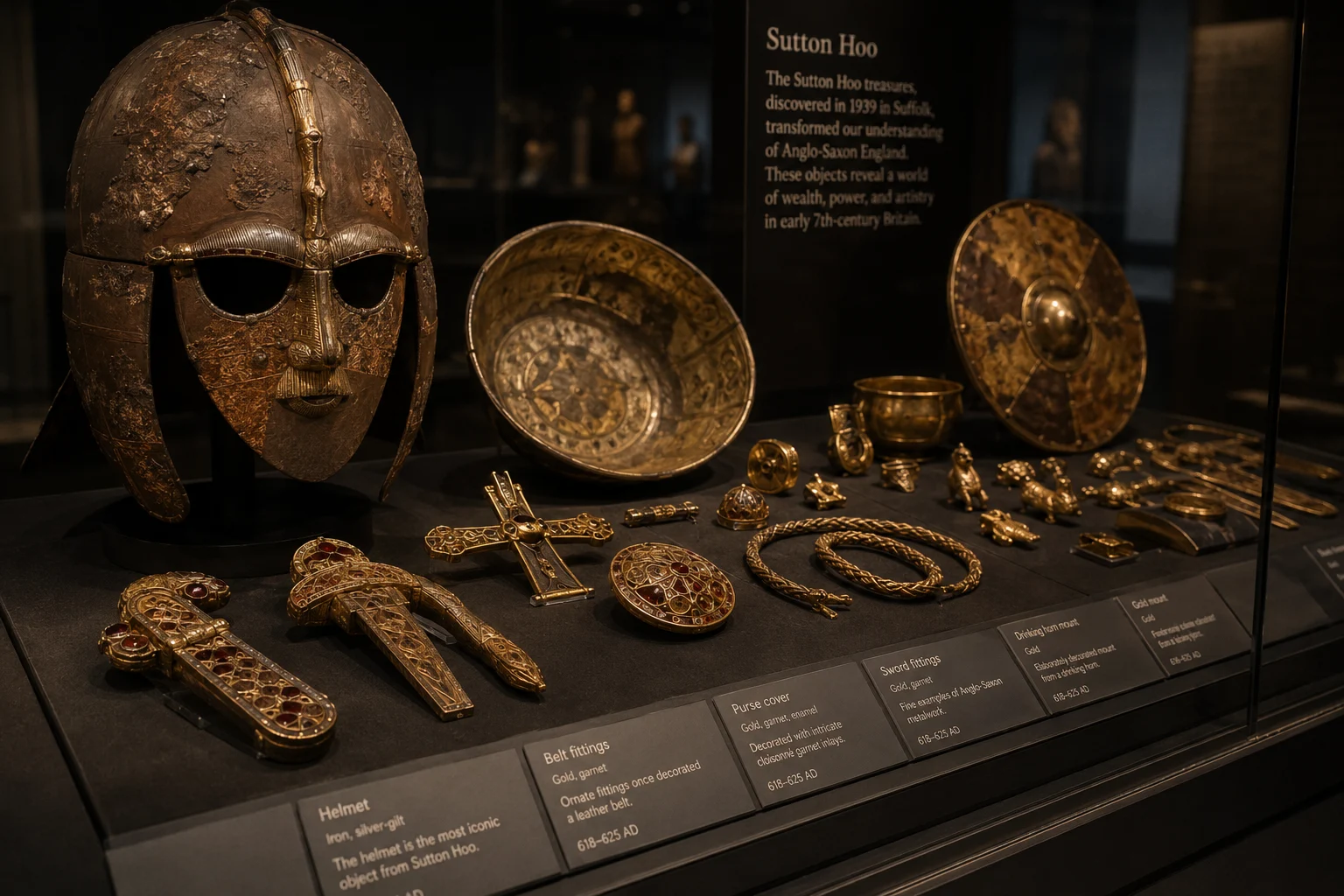
The treasures of this Anglo-Saxon burial transformed historians’ understanding of early medieval England.
Discovered in 1939 in Suffolk, the site revealed a spectacular ship burial within a 27-metre-long vessel, believed to be the final resting place of King Rædwald of East Anglia. Although no human remains survived, the extraordinary grave goods—including the iconic helmet, gold jewellery, weapons, silverware, and Byzantine objects—testify to the wealth and status of the individual buried there.
Today, the Sutton Hoo treasures rank among the greatest highlights of the British Museum. They overturned the long-held view of seventh-century England as a “Dark Age,” revealing instead a sophisticated society with extensive trade networks and cultural connections stretching from Scandinavia to the Mediterranean.
Why the British Museum Changed the Way We Understand History
The British Museum’s greatest achievement lies not in the size of its collection, but in the way it presents human civilisation as a connected story.
It was one of the first museums to demonstrate that history cannot be understood by studying individual nations in isolation. Ancient Greece becomes more meaningful alongside Egypt. Rome is better understood in the context of the Near East. Medieval Europe gains new perspective when viewed alongside the Islamic world.
Rather than telling separate national histories, the British Museum encourages visitors to think in terms of civilisations, cultural exchange, and the shared development of humanity.
Helios Recommends
Before your visit, consider exploring:
- Ernst Gombrich — The Story of Art;
- Kenneth Clark — Civilisation: A Personal View;
- The BBC documentary series Civilisations.
National Gallery
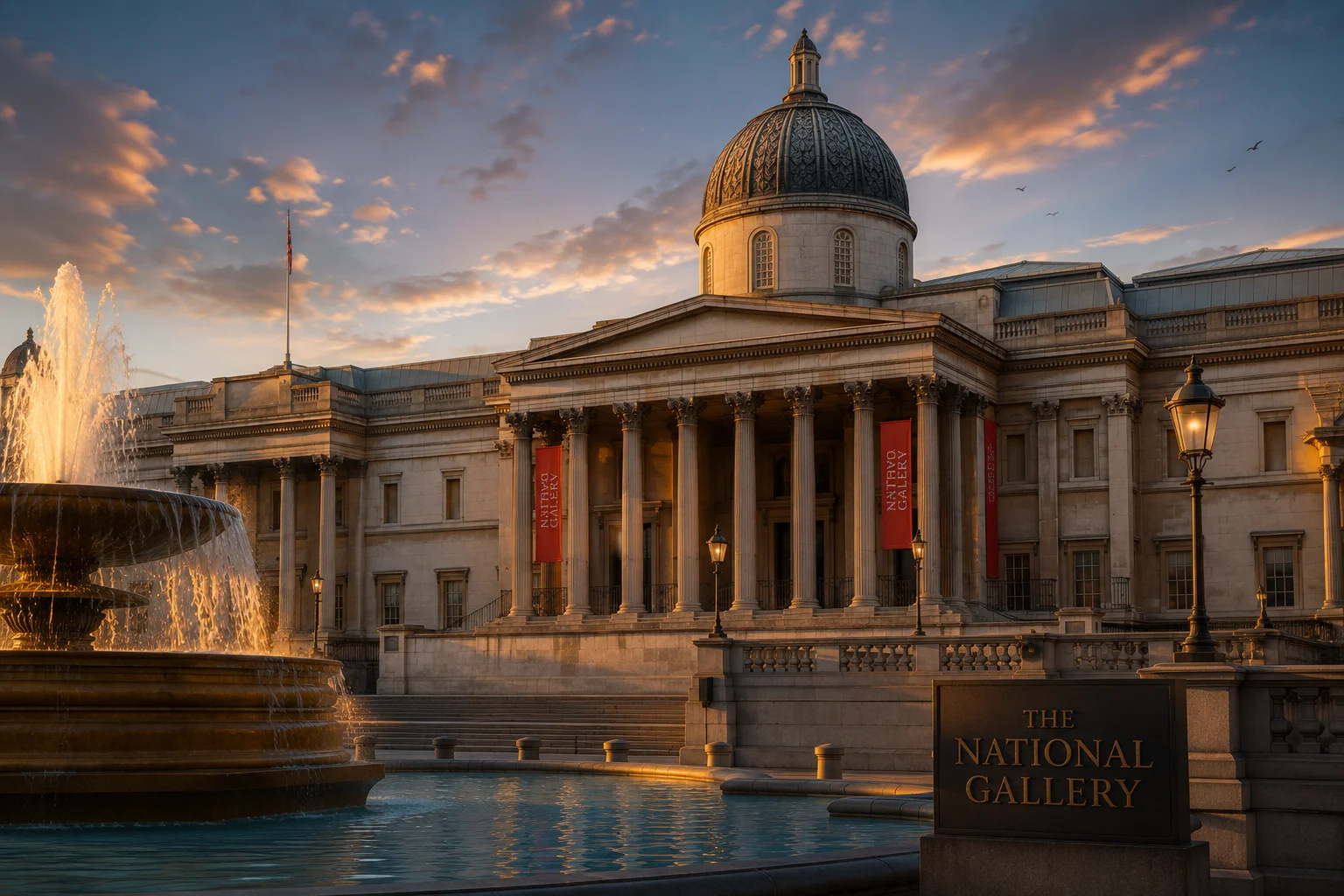
The National Gallery
🌐 https://www.nationalgallery.org.uk
Trafalgar Square, London WC2N 5DN, United Kingdom
If the British Museum tells the story of human civilisation, the National Gallery tells the story of how humanity learned to see.
Founded in 1824, the Gallery began with just thirty-eight paintings acquired by the British government from the banker John Julius Angerstein. Today, its collection comprises more than 2,300 works, spanning the period from the thirteenth to the early twentieth century.
The National Gallery was never intended to become Europe’s largest art museum.
Its ambition was far more refined.
To tell the story of European painting, one masterpiece at a time.
That is why there are almost no accidental works in the collection.
Every painting occupies a carefully considered place within the history of art.
Moving from one gallery to the next feels like travelling through time—from the solemn icons of the Byzantine tradition and the Early Renaissance to the worlds of Leonardo, Raphael, and Titian, before continuing through the Baroque, Romanticism, Realism, and Impressionism.
It is one of the very few museums in the world where the history of European painting unfolds not as a series of isolated masterpieces, but as a continuous narrative.
Admission: Entry to the permanent collection is free. Advance booking is generally not required, although tickets for temporary exhibitions must be purchased separately. During busy periods, visitors may encounter queues at the entrance.
Architecture
Architecture
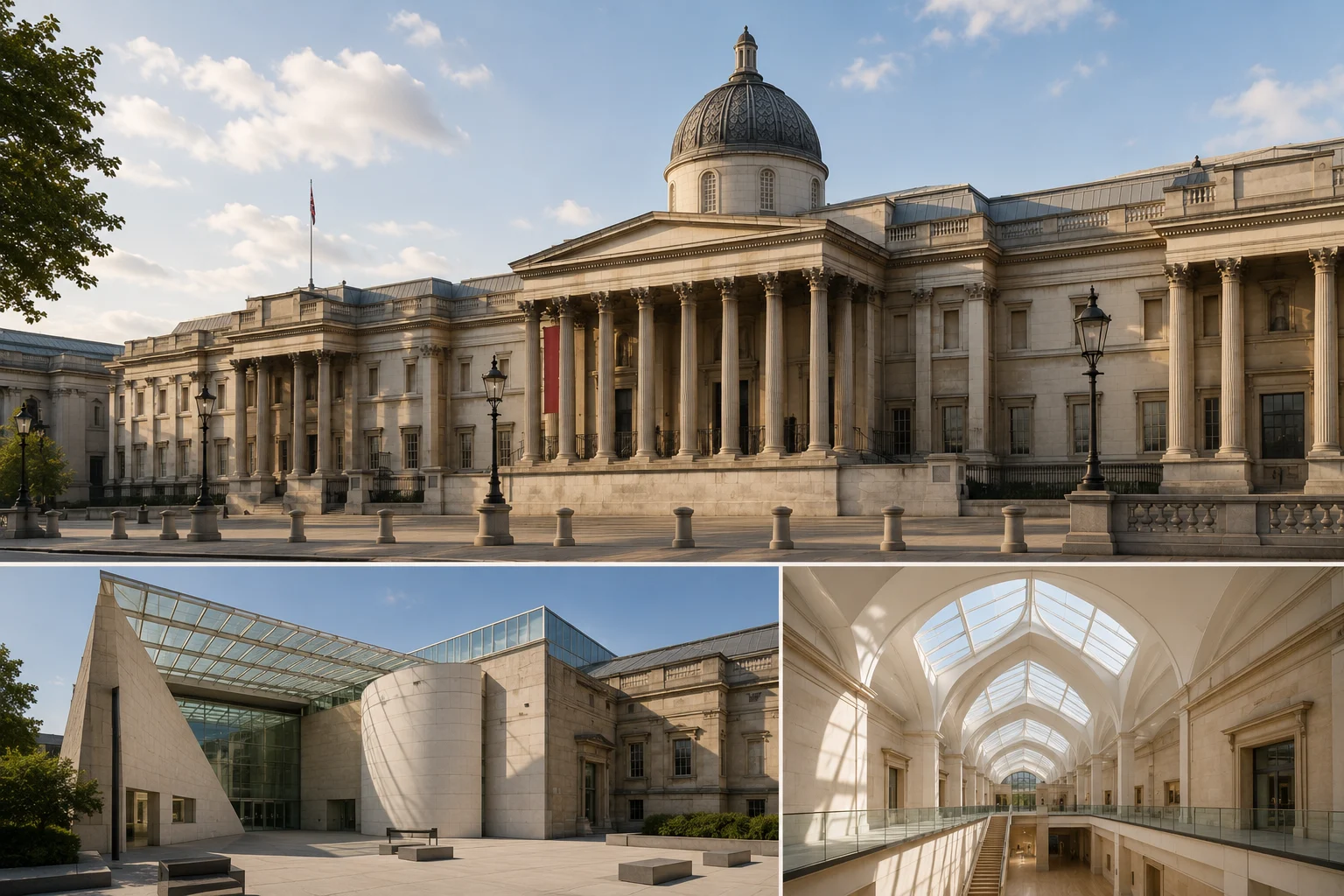
Designed by William Wilkins and opened in 1838, the National Gallery is a landmark of Neoclassical architecture. Its restrained façade on the northern side of Trafalgar Square reflects the institution’s philosophy: the true spectacle lies not in the building itself, but in the masterpieces it houses.
Particular attention should be paid to the Sainsbury Wing, the Gallery’s modern extension designed by architects Robert Venturi and Denise Scott Brown. This is where the journey through the Early Renaissance begins, with architecture that subtly prepares visitors for their first encounter with some of the greatest works in European art.
What You Shouldn’t Miss
Sunflowers — Vincent van Gogh
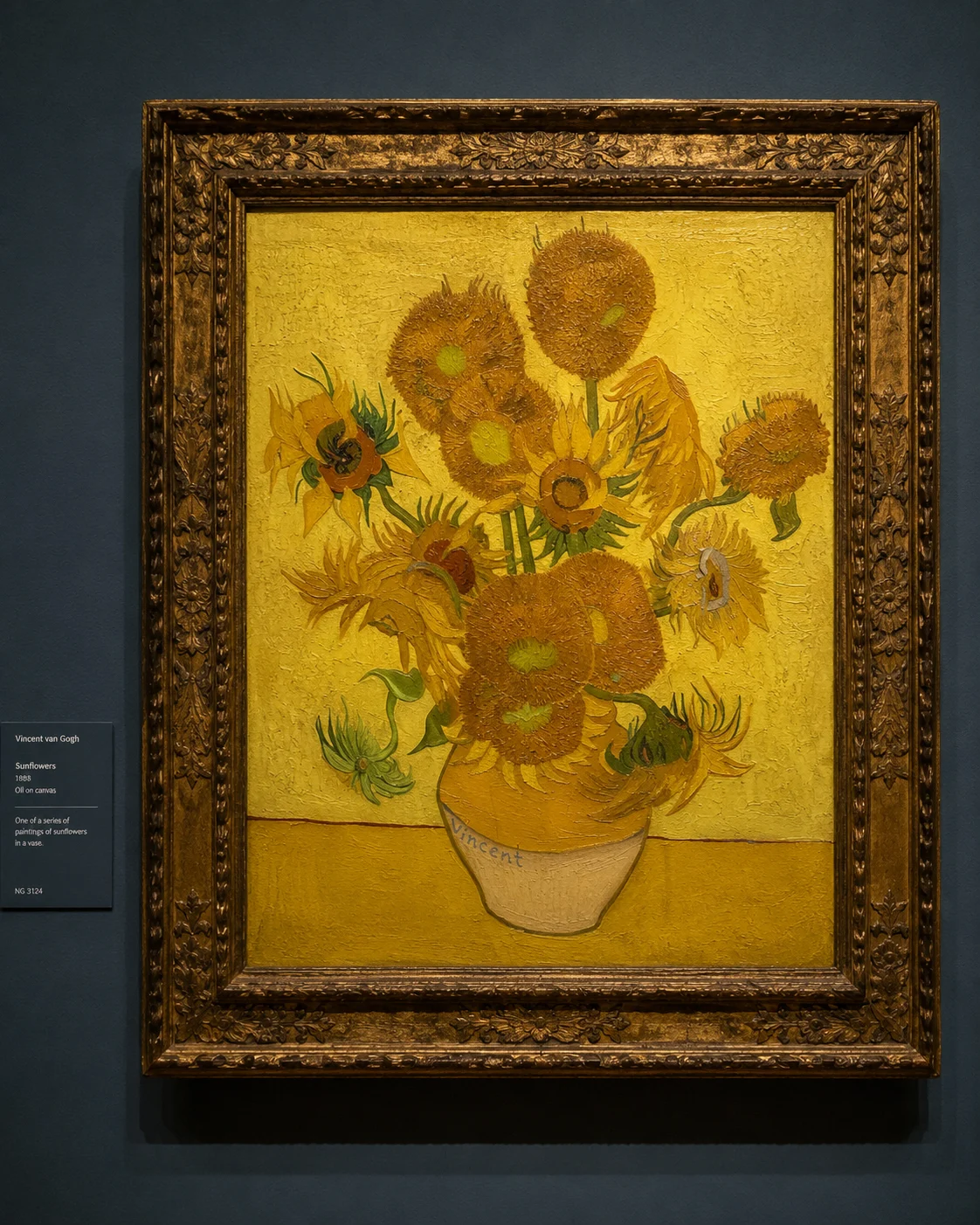
One of the most famous paintings in the world, “Sunflowers” has an entirely different presence in person than it does in reproduction. Standing before the canvas, it becomes immediately clear how masterfully Van Gogh worked with texture, colour, and thick, expressive brushstrokes.
The version housed in London’s National Gallery is part of the celebrated series painted in 1888 to decorate Van Gogh’s house in Arles, where he was preparing for the arrival of his friend and fellow artist Paul Gauguin. Today, it is regarded as one of the defining masterpieces of Post-Impressionism and an enduring symbol of Van Gogh’s artistic legacy.
Viewed up close, the painting reveals an almost sculptural surface. Van Gogh applied the paint so thickly that the petals and seed heads seem to rise from the canvas. It is this remarkable physical quality—impossible to capture in photographs or digital reproductions—that makes seeing the original such an unforgettable experience.
The Ambassadors — Hans Holbein the Younger
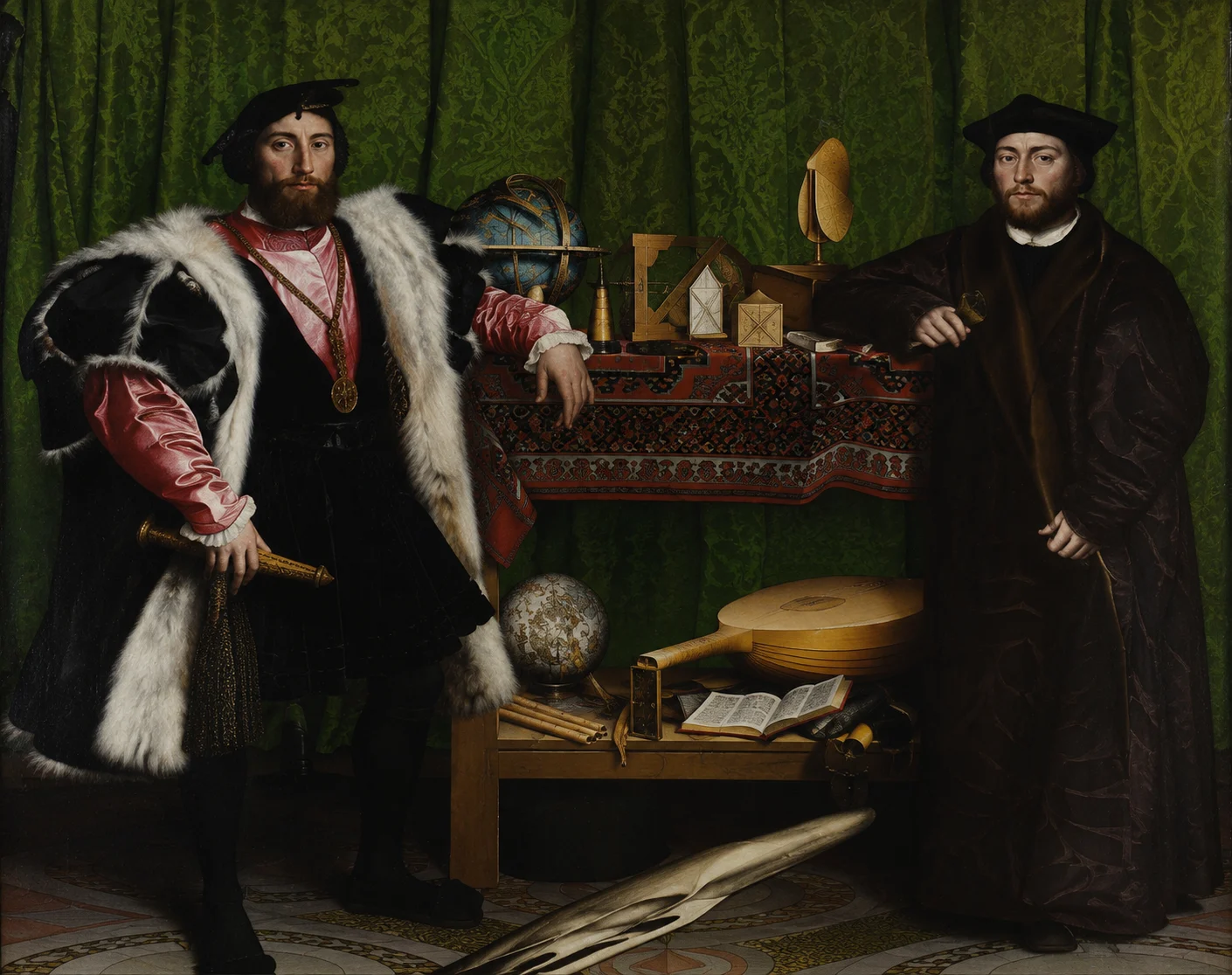
A masterpiece of the Northern Renaissance, “The Ambassadors” is renowned for its extraordinary anamorphosis—an elongated image of a human skull that can only be recognised when viewed from a sharp angle. The painting is both a technical marvel and a profound meditation on knowledge, power, and the inevitability of death.
Painted in 1533, it portrays two French diplomats surrounded by scientific instruments, musical instruments, books, and globes—symbols of learning, culture, and the intellectual achievements of the Renaissance. Yet the most striking detail lies at the bottom of the composition: a distorted skull that reveals itself only from an oblique viewpoint.
This remarkable optical illusion serves as a memento mori, reminding viewers that wealth, influence, and knowledge cannot overcome the passage of time. The combination of technical brilliance, rich symbolism, and philosophical depth has made “The Ambassadors” one of the National Gallery’s most celebrated and endlessly discussed masterpieces.
The Virgin of the Rocks — Leonardo da Vinci
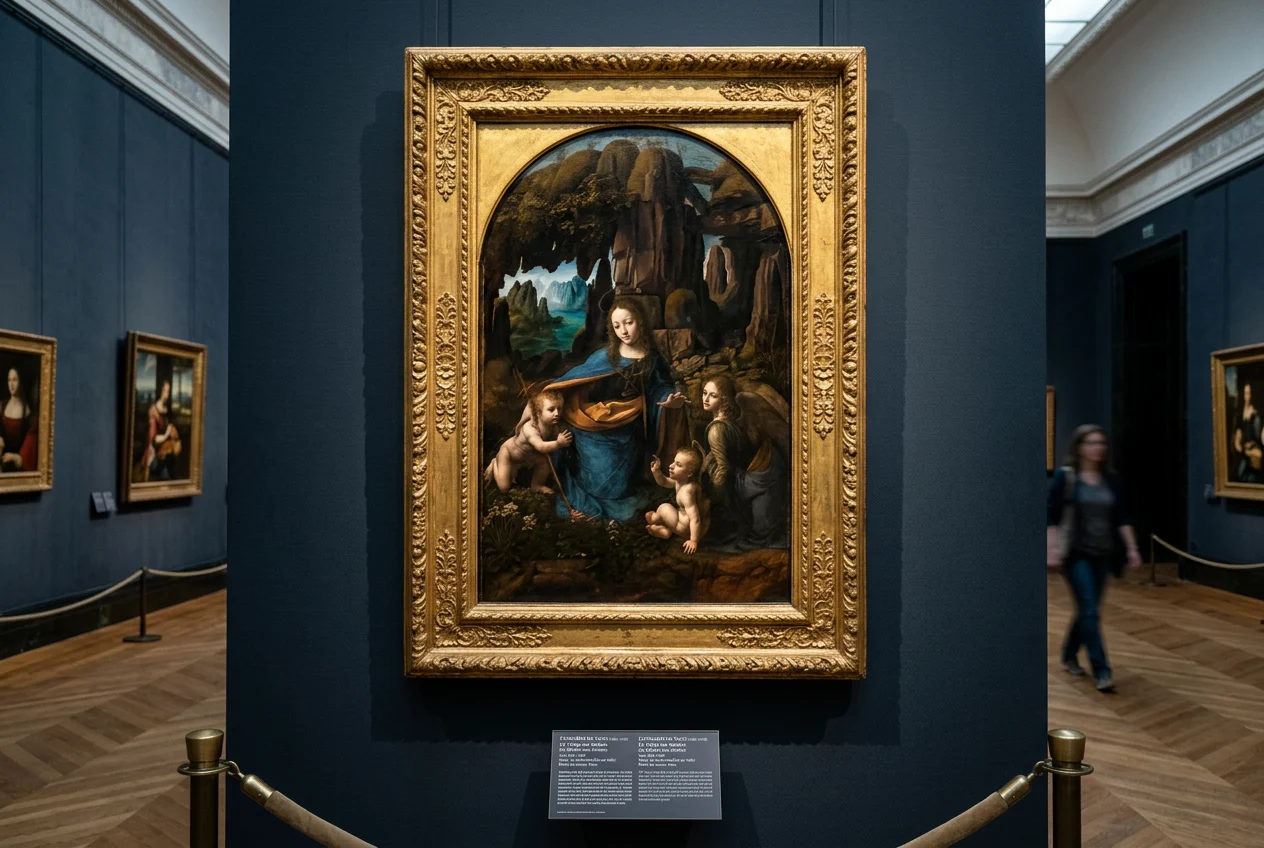
One of the two surviving versions painted by Leonardo da Vinci, “The Virgin of the Rocks” is a remarkable demonstration of his mastery of light, atmosphere, and psychological subtlety.
The version in London’s National Gallery was developed over more than twenty years and differs significantly from the painting in the Louvre. Working alongside his assistants, Leonardo refined parts of the composition, creating figures that are more monumental, expressive, and spiritually charged.
Particular attention should be paid to Leonardo’s celebrated sfumato technique—the delicate transitions between light and shadow that give the faces and figures their extraordinary softness and lifelike presence. Surrounded by a mysterious rocky landscape, the Virgin Mary, the Christ Child, Saint John the Baptist, and the angel seem to emerge gradually from the darkness, creating an atmosphere of quiet contemplation. The subtle interplay of light, space, and emotion makes this one of the finest masterpieces of the High Renaissance.
Venus and Mars — Sandro Botticelli
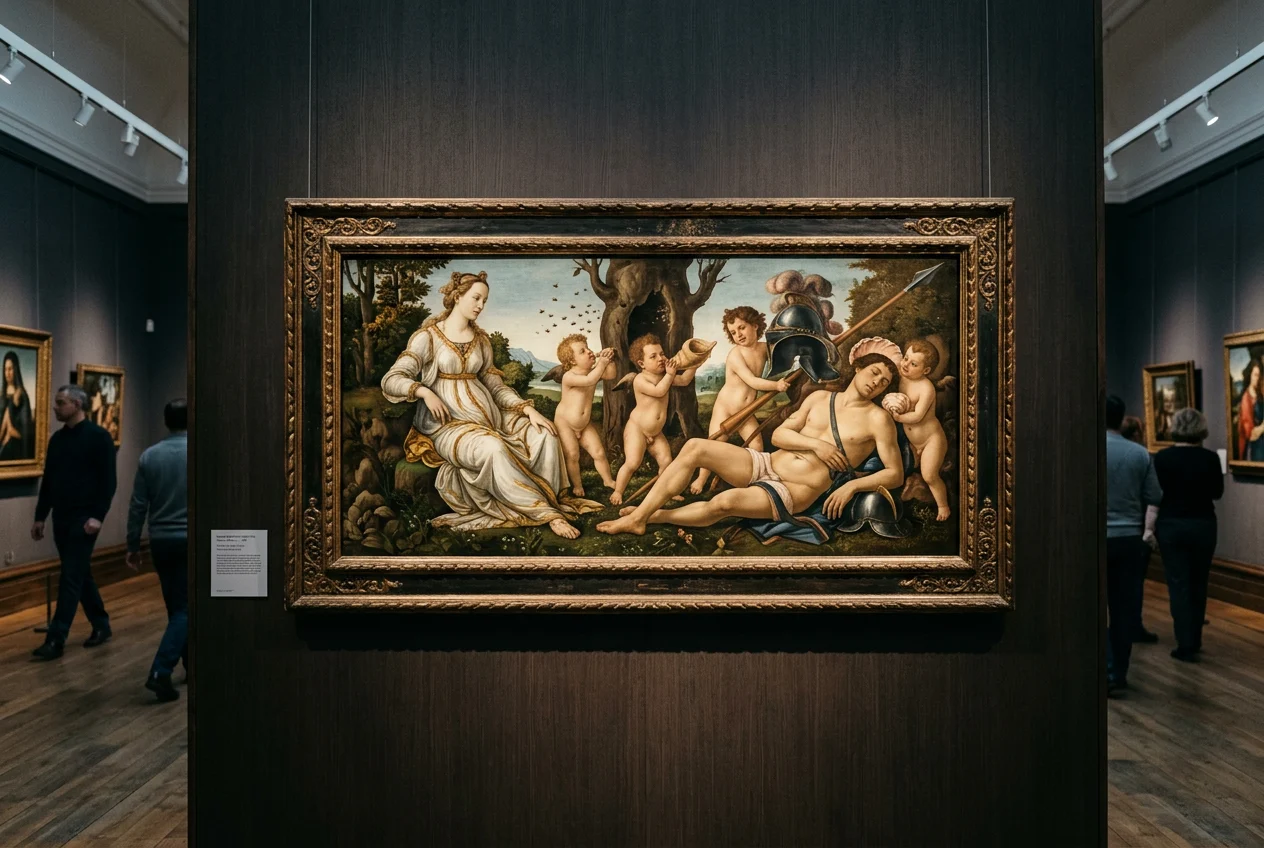
More than a mythological scene, “Venus and Mars” is an allegory of love, peace, and human nature.
In the painting, Venus, the goddess of love, sits awake and composed, while Mars, the god of war, lies fast asleep after their encounter. Around him, playful satyrs steal and toy with his weapons and armour, suggesting that the power of love ultimately triumphs over the force of war. This humanist idea was especially popular in Renaissance Florence, where classical mythology was often used to express philosophical and moral concepts.
Painted around 1485, the work is regarded as one of Botticelli’s most elegant creations. Its graceful figures, balanced composition, and rich symbolic detail exemplify the refinement of Florentine Renaissance painting, making it one of the National Gallery’s most celebrated masterpieces.
The Arnolfini Portrait — Jan van Eyck
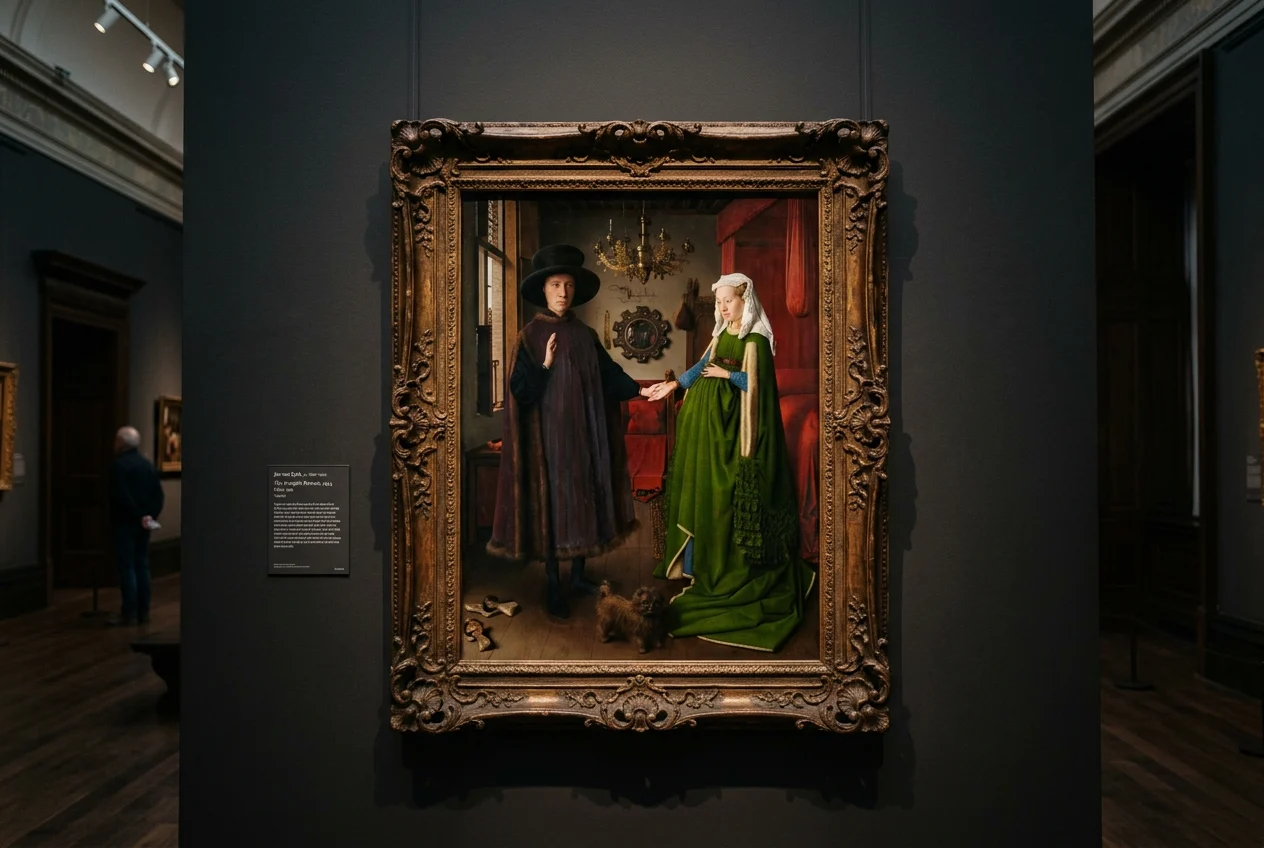
This masterpiece by Jan van Eyck is housed in the National Gallery.
Indeed, it is here—and it remains one of the greatest portraits of the fifteenth century, filled with symbols that continue to fascinate and challenge art historians.
Painted in 1434, “The Arnolfini Portrait” is regarded as one of the earliest masterpieces of Northern Renaissance oil painting. Van Eyck demonstrates extraordinary technical skill, rendering the textures of fabric, wood, metal, and glass with remarkable precision and revealing the full expressive potential of the relatively new medium of oil paint.
One of the painting’s most captivating details is the small convex mirror on the back wall. It reflects not only the couple but also two additional figures, one of whom may be the artist himself. Around the mirror are miniature scenes from the Passion of Christ, while almost every object in the room—from the single lit candle and the little dog to the oranges and the wooden clogs—has been interpreted as carrying symbolic meaning. This extraordinary richness of detail and ambiguity has made “The Arnolfini Portrait” one of the most studied and enigmatic works in the history of European art.
The Fighting Temeraire — J. M. W. Turner
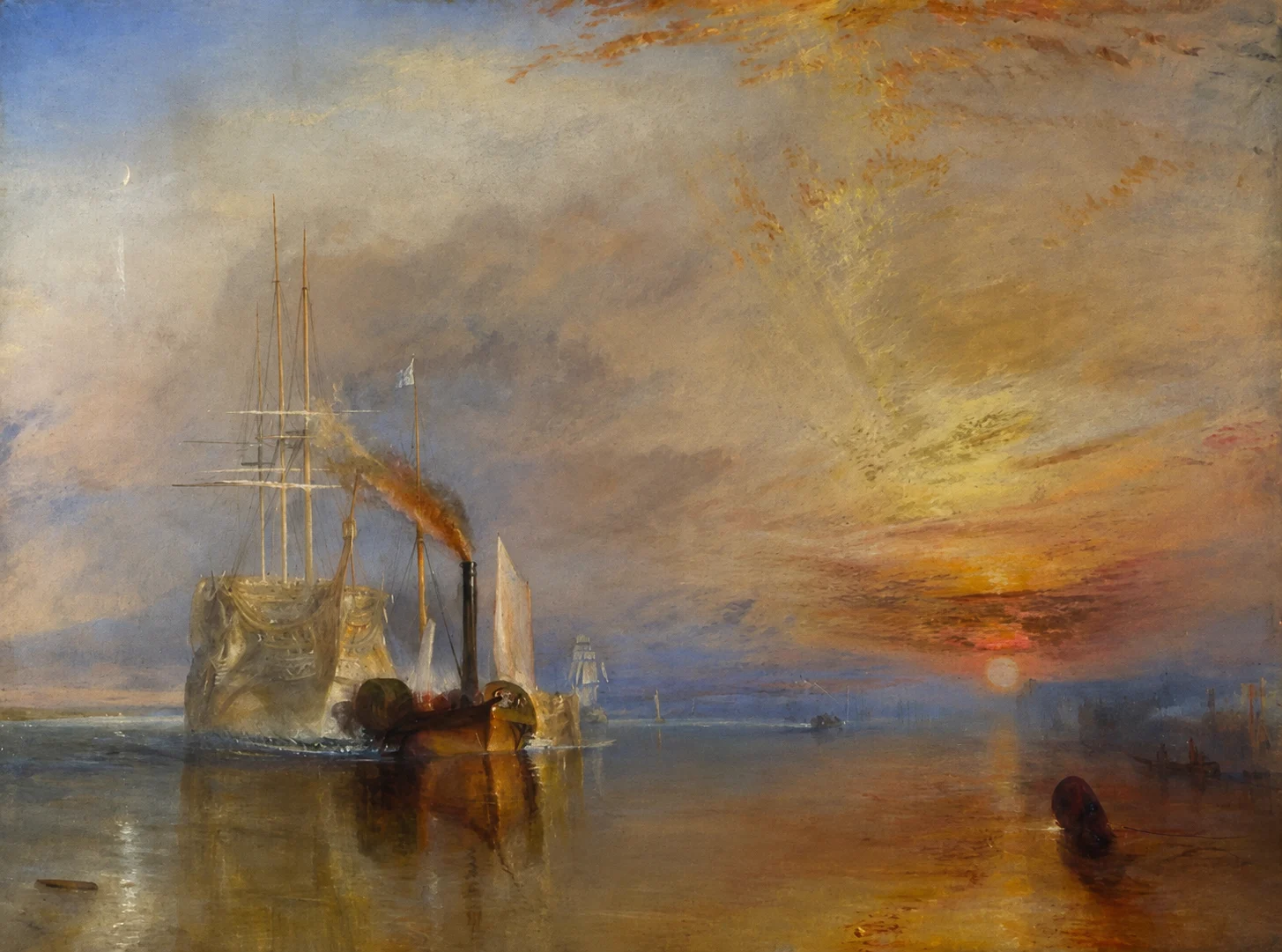
A painting that has become a symbol of the end of the Age of Sail and the rise of industrial Britain.
Turner painted “The Fighting Temeraire” in 1839, inspired by a real event: the legendary warship HMS Temeraire, celebrated for its role in the Battle of Trafalgar, was towed by a small steam tug to be broken up. Rather than creating a historically accurate record, Turner transformed the scene into a powerful allegory of a changing world, where the grandeur of the sailing ship gives way to the unstoppable advance of the industrial age.
The painting’s emotional power lies in its luminous sunset and shimmering reflections across the water. The contrast between the ghostly white silhouette of the old warship and the dark, smoke-belching steam tug underscores the inevitability of technological progress. Today, “The Fighting Temeraire” is regarded as one of the National Gallery’s greatest masterpieces and one of the most beloved paintings in the history of British art.
The Hay Wain — John Constable
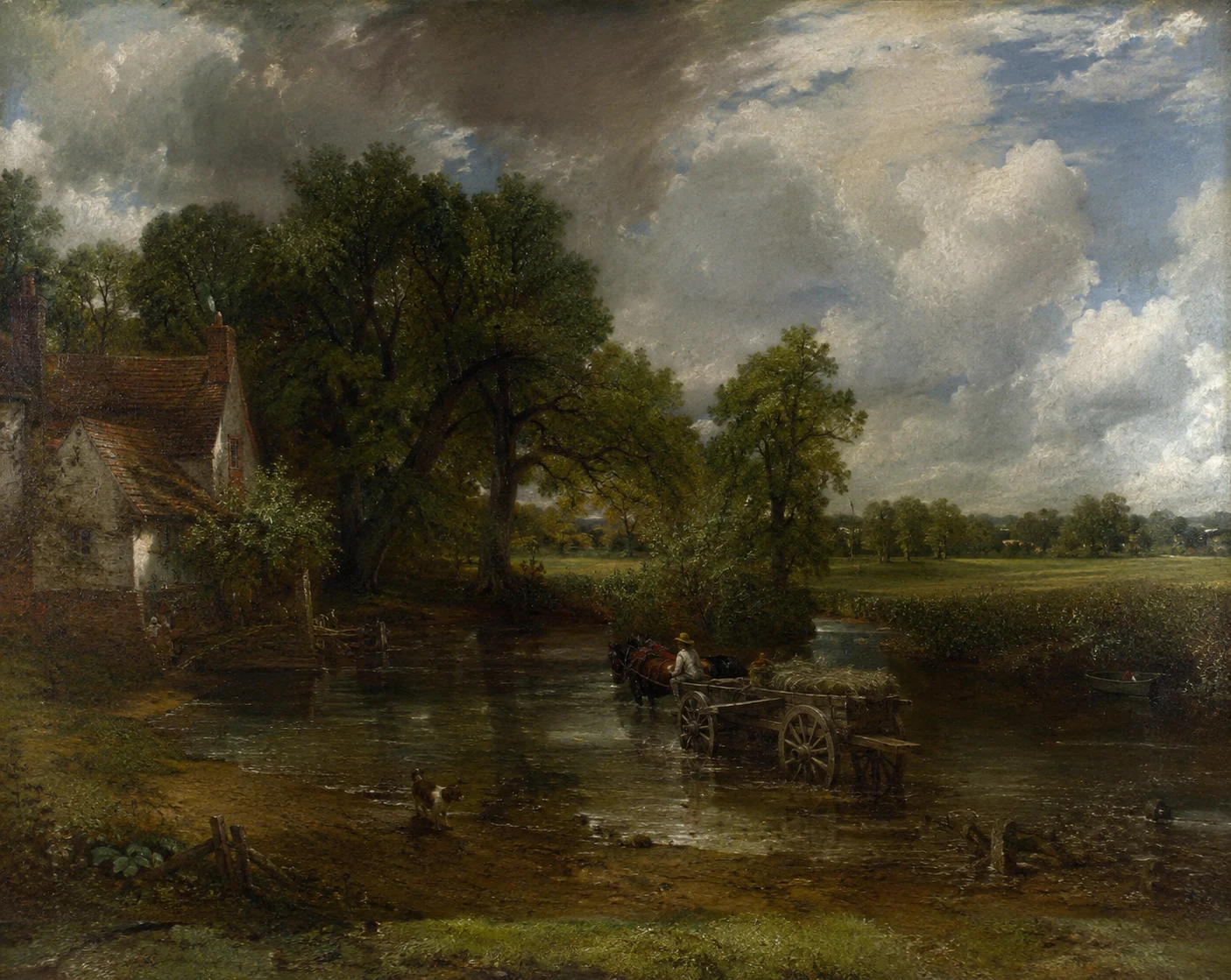
A painting that transformed the tradition of European landscape painting and profoundly influenced generations of nineteenth-century French artists.
Painted in 1821, “The Hay Wain” depicts a quiet rural scene in Suffolk, the county where Constable was born and raised. At the centre of the composition, a farm cart crosses a shallow river, while the surrounding countryside is rendered with extraordinary sensitivity to light, atmosphere, and the smallest details of the natural world.
Although the painting received only modest recognition in Britain during Constable’s lifetime, it caused a sensation when exhibited at the Paris Salon of 1824. Its fresh, natural approach inspired French landscape painters, particularly the artists of the Barbizon School, and later the Impressionists. Today, “The Hay Wain” is regarded as one of the National Gallery’s greatest masterpieces and an enduring symbol of British landscape painting.
Caravaggio’s Paintings
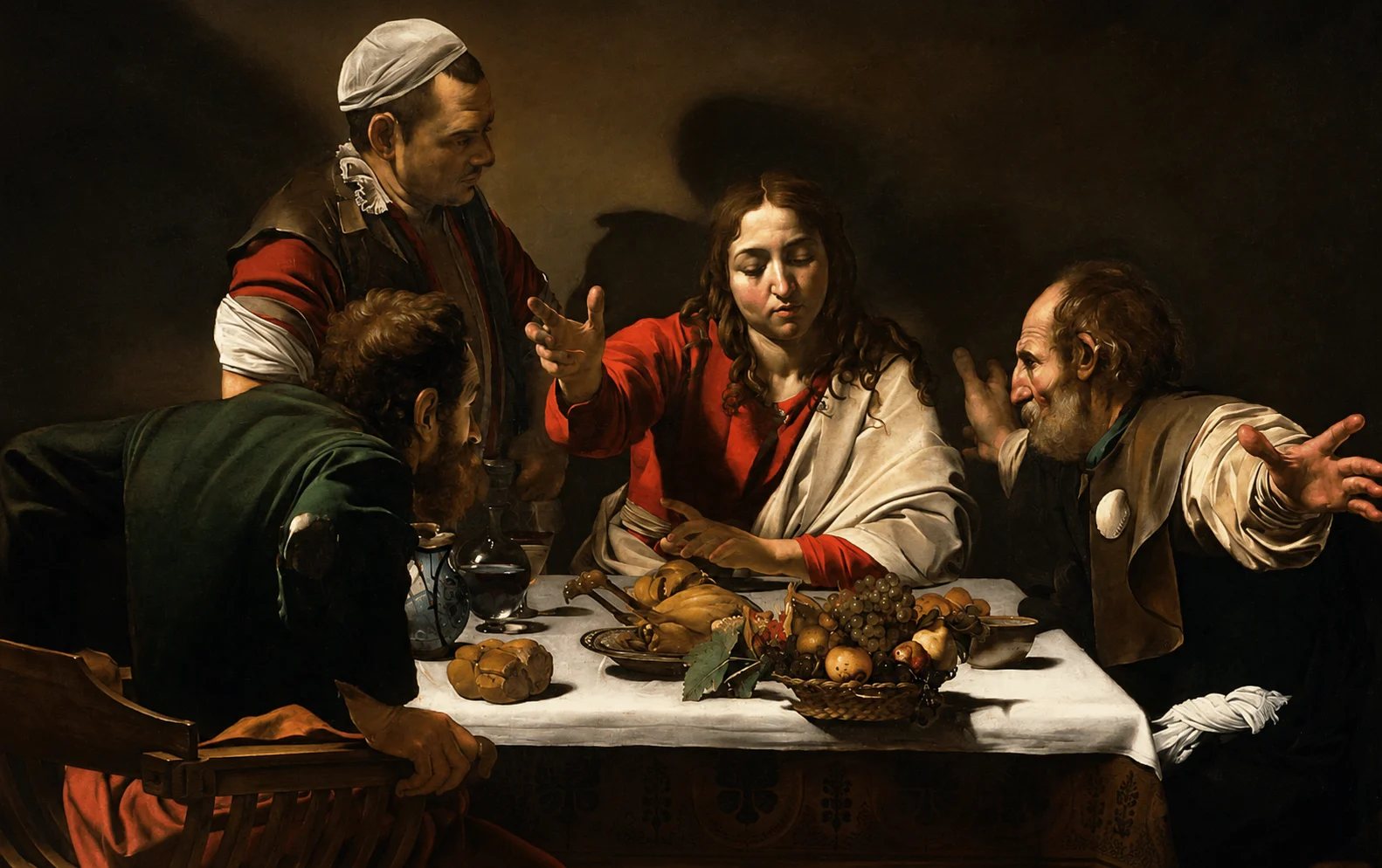
His dramatic use of light transformed the course of European painting and inspired generations of artists.
The National Gallery holds one of the finest collections of Caravaggio’s works outside Italy. Among its highlights are “The Supper at Emmaus,” “Salome Receives the Head of John the Baptist,” and “Boy Bitten by a Lizard.” Together, these paintings reveal the evolution of the artist’s approach to composition, light, and the depiction of human emotion.
Rejecting the idealised figures of his time, Caravaggio portrayed saints and biblical heroes as ordinary people. His celebrated use of chiaroscuro—the dramatic contrast between light and shadow—heightened the emotional intensity of his scenes and created the illusion that the action was unfolding directly before the viewer. This revolutionary approach had a profound impact on seventeenth-century European art and gave rise to an entire generation of followers known as the Caravaggisti.
Why the National Gallery Changed the History of Art
Unlike many museums, the National Gallery does not seek to impress through the sheer size of its collection. Instead, it presents a coherent narrative of the development of European painting.
Here, it becomes clear how artists gradually learned to represent space, light, human emotion, and individual character. The Gallery demonstrates that art is an ongoing conversation across generations, with each master responding to the achievements and ideas of those who came before.
Great painting demands not speed, but attention.
In an age when images are consumed in seconds, masterpieces reveal themselves only to those willing to slow down. Sometimes, spending ten minutes with a single painting offers a richer experience than rushing through dozens of galleries.
During the Second World War, the National Gallery’s collection was evacuated to slate mines in Wales for safekeeping. While the paintings were away, the empty building hosted regular lunchtime concerts, helping to sustain the morale of Londoners throughout the war.
Helios Recommends
Before your visit, consider exploring:
- John Berger — Ways of Seeing;
- Michael Baxandall — Painting and Experience in Fifteenth-Century Italy;
- The BBC documentary series The Private Life of a Masterpiece.
Victoria and Albert Museum (V&A)
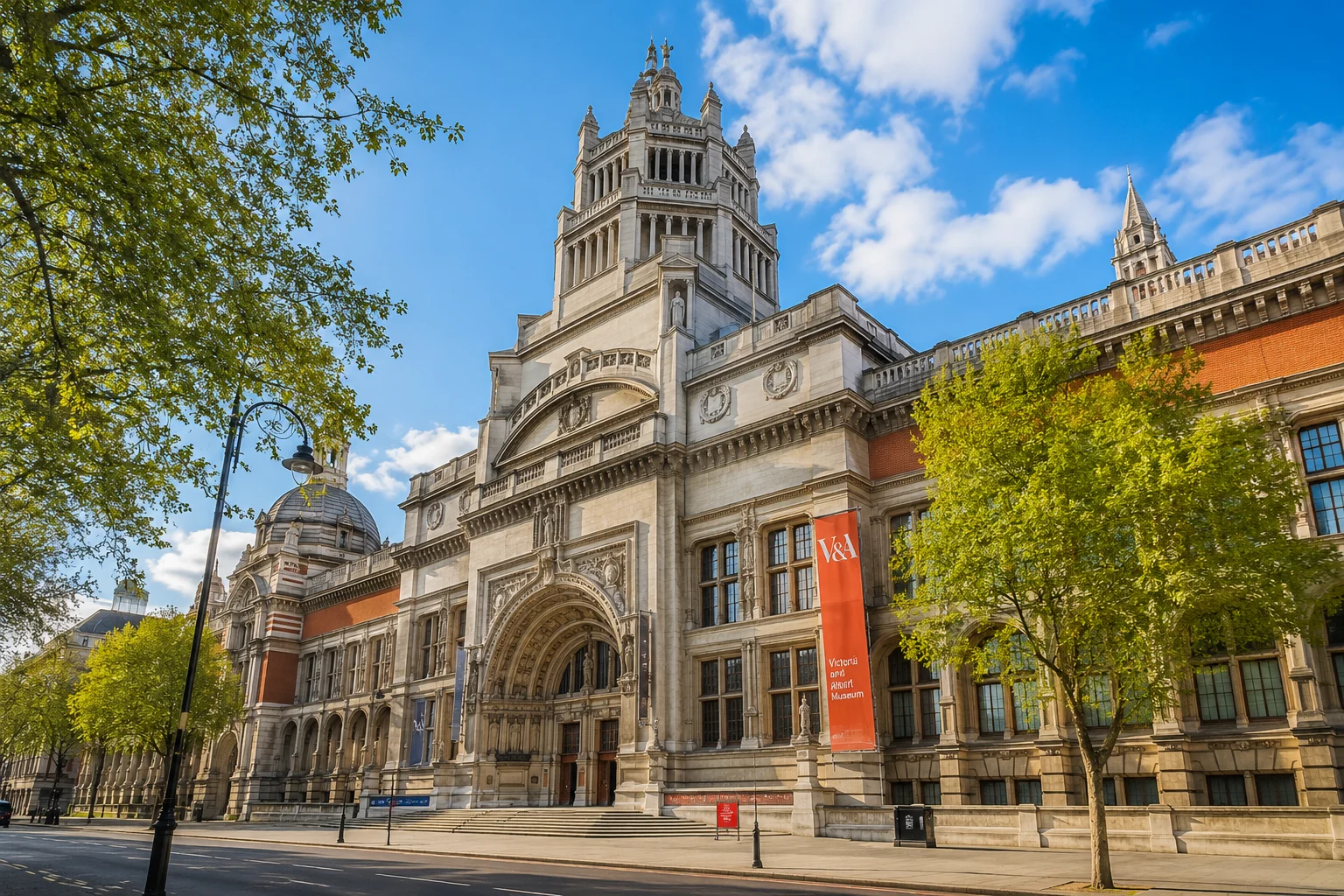
Victoria and Albert Museum (V&A)
Cromwell Road, London SW7 2RL, United Kingdom
While most art museums tell the story of painting and sculpture, the Victoria and Albert Museum is devoted to a different, equally important subject:
the history of human taste.
Founded in 1852 in the aftermath of the Great Exhibition of 1851, the museum was conceived from the outset as an educational institution for artists, architects, designers, and craftsmen.
Prince Albert believed that good design could transform not only industry but society itself.
That conviction became the foundation of the V&A’s philosophy.
Today, the museum is home to the world’s largest collection of decorative arts and design, with more than 2.8 million objects. Its galleries bring together medieval stained glass, Renaissance furniture, jewellery, theatre costumes, photography, ceramics, textiles, fashion, and contemporary design.
Each gallery explores how ideas of beauty, craftsmanship, and function have evolved across different cultures and historical periods.
What makes the V&A unique is its refusal to separate fine art from everyday life.
Art does not exist only on gallery walls.
It is present in the clothes we wear, the furniture we use, the books we read, the buildings we inhabit, and the objects that shape our daily lives.
Admission: Entry to the permanent collection is free. Temporary exhibitions usually require a separate ticket, and advance booking is recommended for the museum’s most popular exhibitions.
Architecture
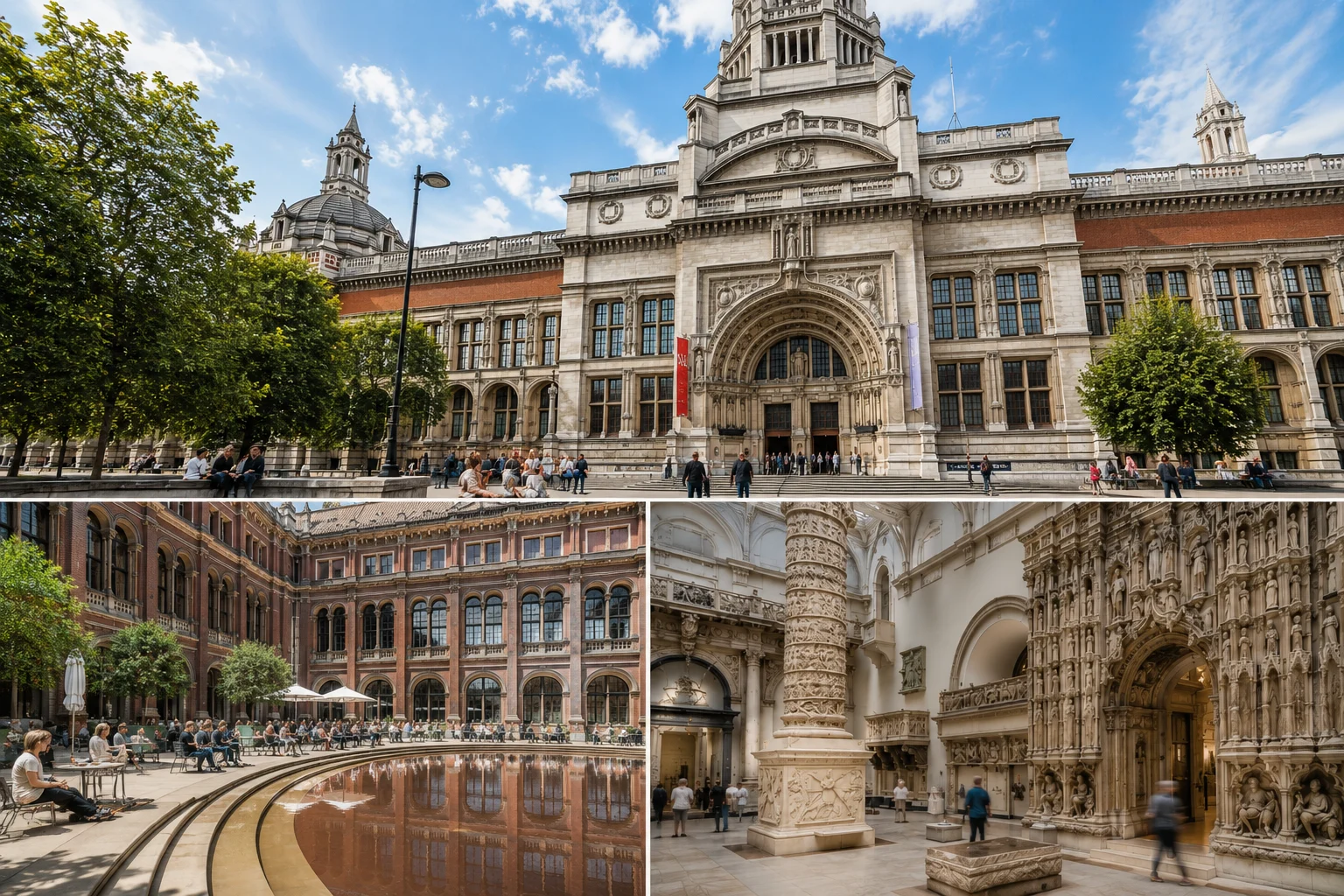
The museum is a work of art in its own right.
Constructed over almost half a century, the V&A is an extraordinary blend of Victorian Gothic Revival, Italian Renaissance Revival, and Edwardian architecture. Rather than following a single architectural style, the complex reflects the museum’s own collections—layered, diverse, and shaped by different periods of history.
Particular attention should be paid to the John Madejski Garden, a peaceful courtyard with a shallow reflecting pool that becomes a popular gathering place for Londoners during the summer. It is a reminder that a museum can be more than a place for contemplation—it can also be an integral part of everyday urban life.
Equally remarkable are the Cast Courts, two monumental galleries housing full-scale plaster casts of some of the world’s greatest architectural and sculptural masterpieces. Here, visitors can see a life-sized reproduction of Trajan’s Columnalongside casts of medieval cathedral portals and other iconic monuments that could never be brought together in their original form.
What You Shouldn’t Miss
Cast Courts
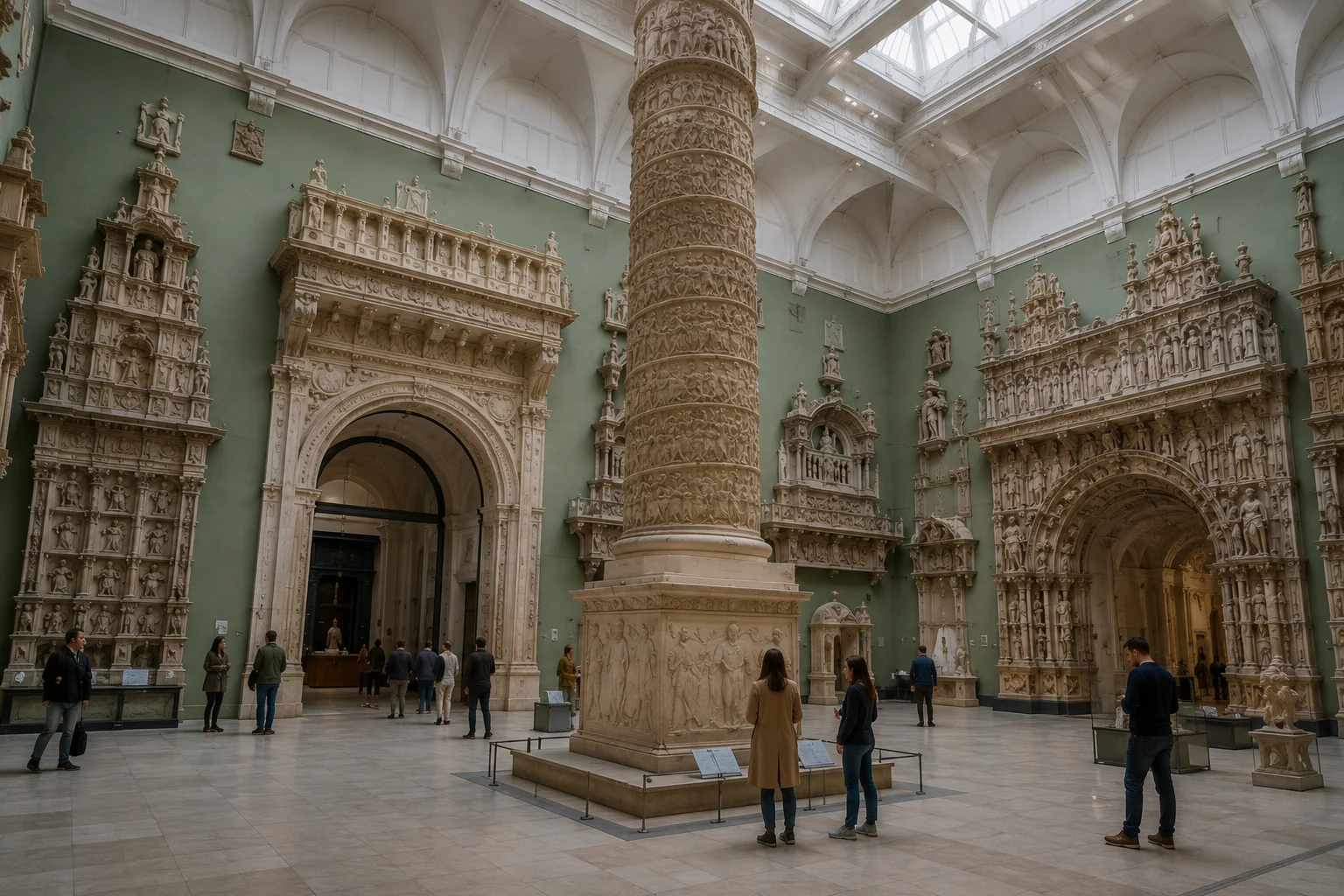
The most unusual part of the museum.
In the nineteenth century, plaster casts were regarded as the best way to study the world’s artistic masterpieces. The V&A therefore assembled full-scale replicas of some of the greatest works of architecture and sculpture, allowing students, artists, and the public to experience them without travelling across Europe. Today, the Cast Courts are historic exhibits in their own right—a reminder of the Victorian belief that great art should be accessible to everyone through education.
Raphael Cartoons
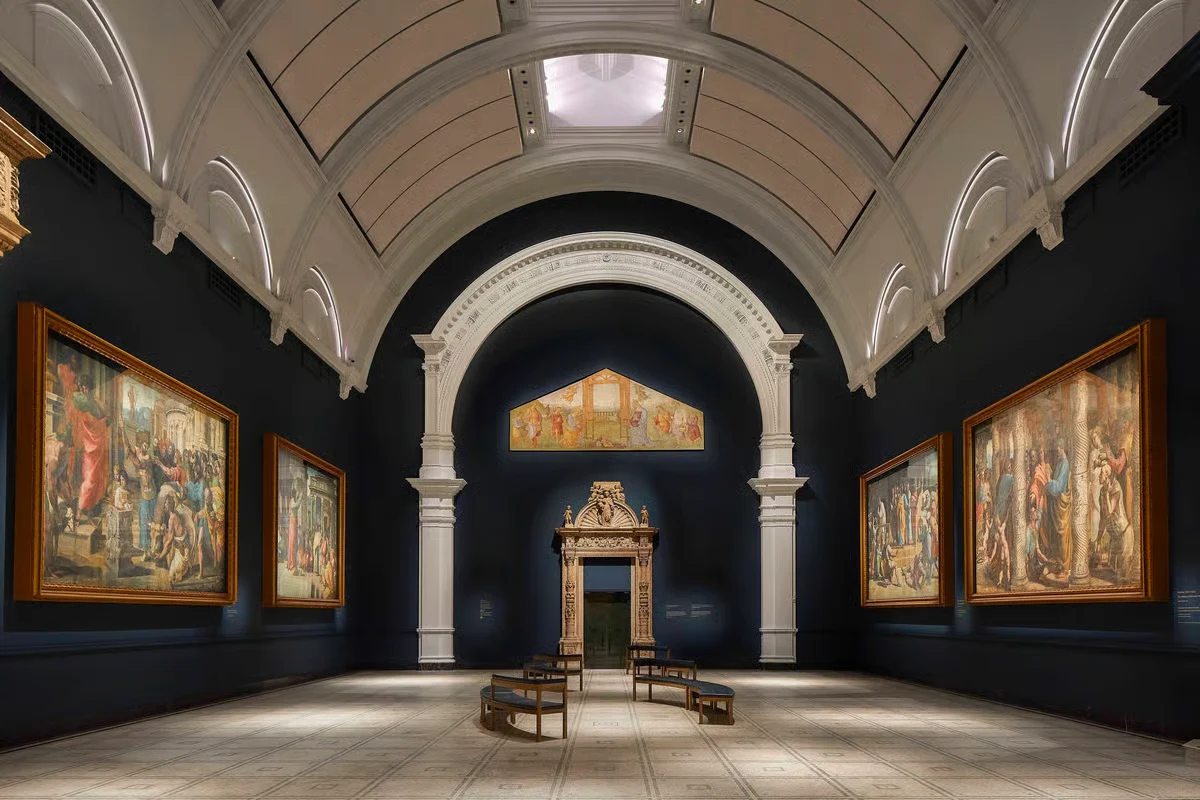
Huge full-scale cartoons by Raphael, created as preparatory designs for the tapestries of the Sistine Chapel. They offer a rare opportunity to step inside the workshop of one of the greatest Renaissance masters and witness the creative process behind monumental art.
Commissioned by Pope Leo X around 1515, the cartoons were used as templates for tapestries depicting scenes from the lives of Saint Peter and Saint Paul. Their exceptional state of preservation allows visitors to appreciate Raphael’s remarkable draughtsmanship, dynamic compositions, and expressive figures in extraordinary detail. Today, they are regarded not only as preparatory works but as masterpieces in their own right and among the greatest treasures of the Victoria and Albert Museum..
The Ardabil Carpet
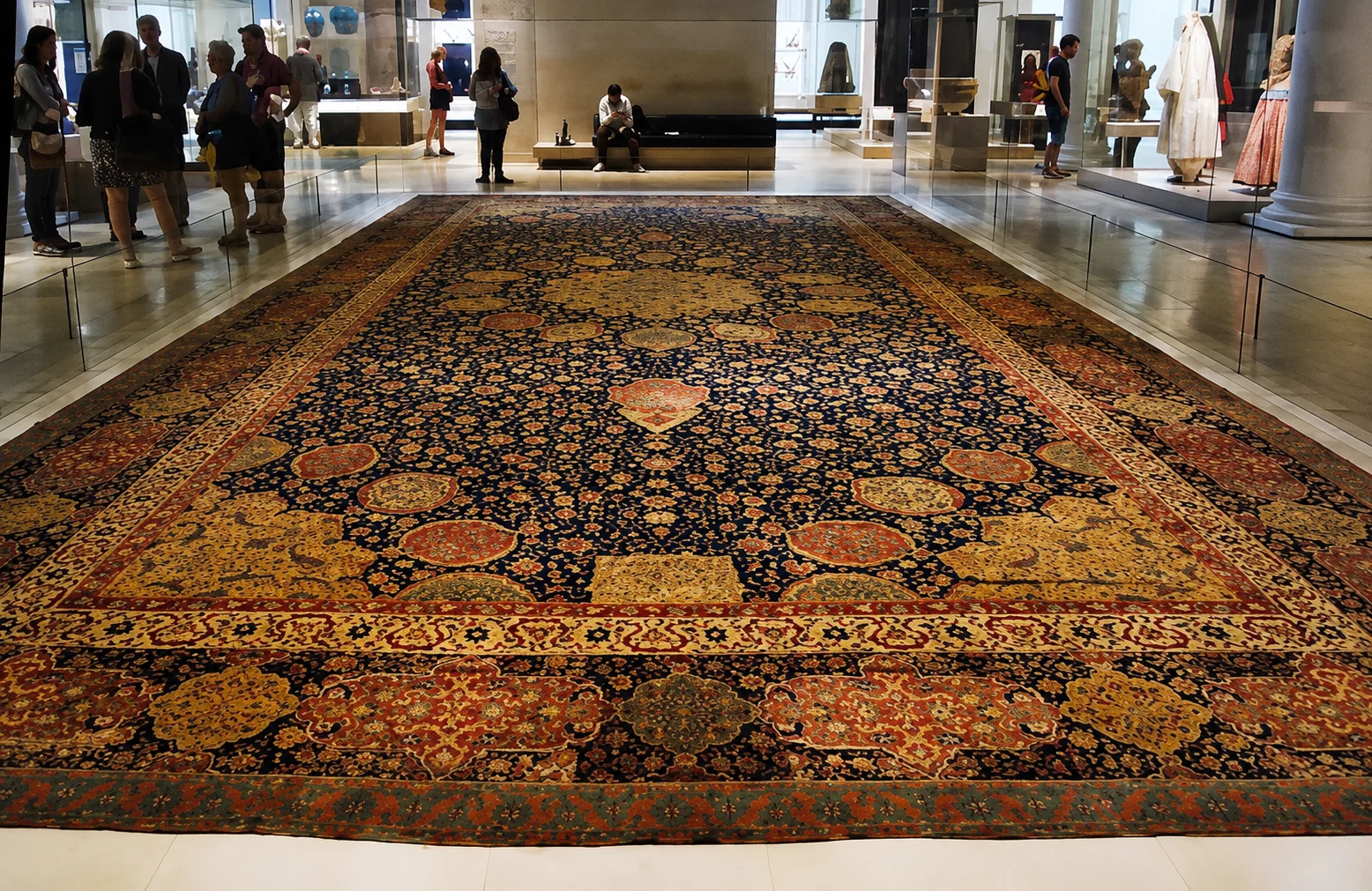
One of the most beautiful Islamic carpets ever created, woven in sixteenth-century Persia. It is regarded not only as a masterpiece of decorative art, but as one of the greatest achievements of world cultural heritage.
Created during the Safavid period, the Ardabil Carpet is celebrated for its extraordinary craftsmanship, harmonious proportions, and intricate floral design centred on a magnificent medallion. Woven from silk and wool with exceptional precision, it reflects the artistic and technical excellence of Persian carpet making at its height. Today, it is considered one of the finest surviving carpets in the world and one of the Victoria and Albert Museum’s greatest treasures.
Jewellery Collection
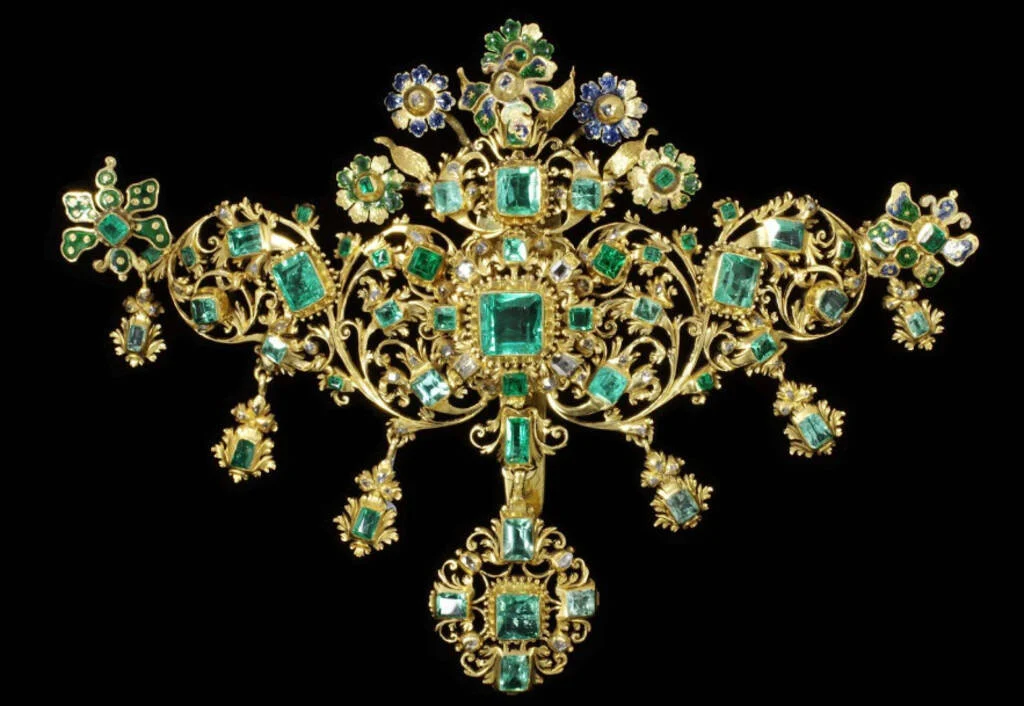
From medieval treasures to contemporary designer creations, this collection traces the changing history of luxury over nearly two thousand years. The V&A’s jewellery galleries bring together royal ornaments, Renaissance gems, Art Nouveau masterpieces, and works by some of today’s leading jewellery designers. Beyond their beauty, these objects reveal how jewellery has served not only as decoration, but also as a symbol of power, identity, craftsmanship, and artistic innovation across different cultures and historical periods.
Fashion Gallery
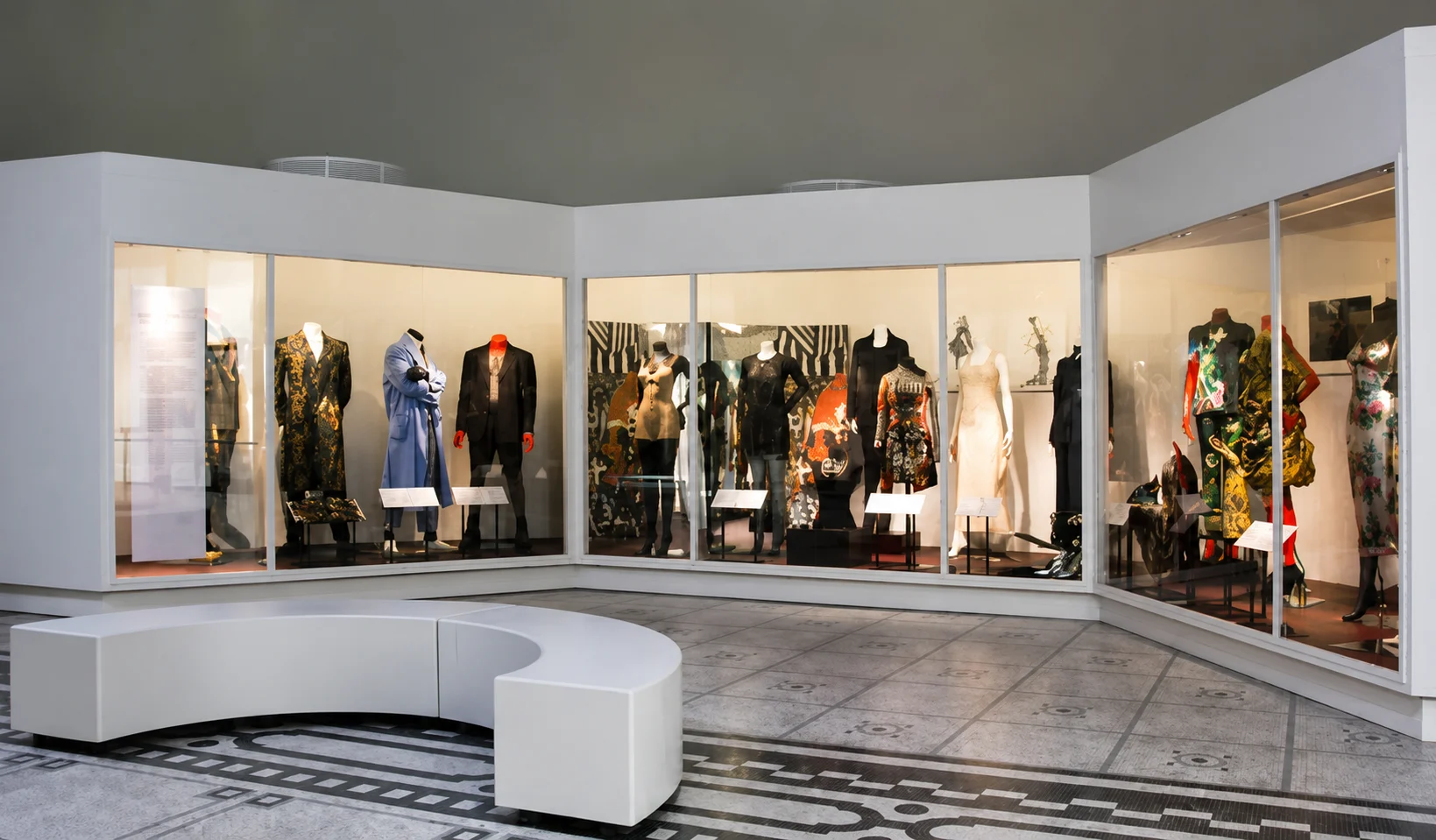
One of the world’s finest collections of fashion.
From the elegant silhouettes of the eighteenth century to the visionary creations of Alexander McQueen, Christian Dior, Cristóbal Balenciaga, and Vivienne Westwood, the gallery reveals how clothing reflects the social, political, and cultural values of its time. More than a display of beautiful garments, the collection demonstrates that fashion is a form of artistic expression—one that shapes identity, challenges convention, and captures the spirit of every era.
Medieval Sculpture
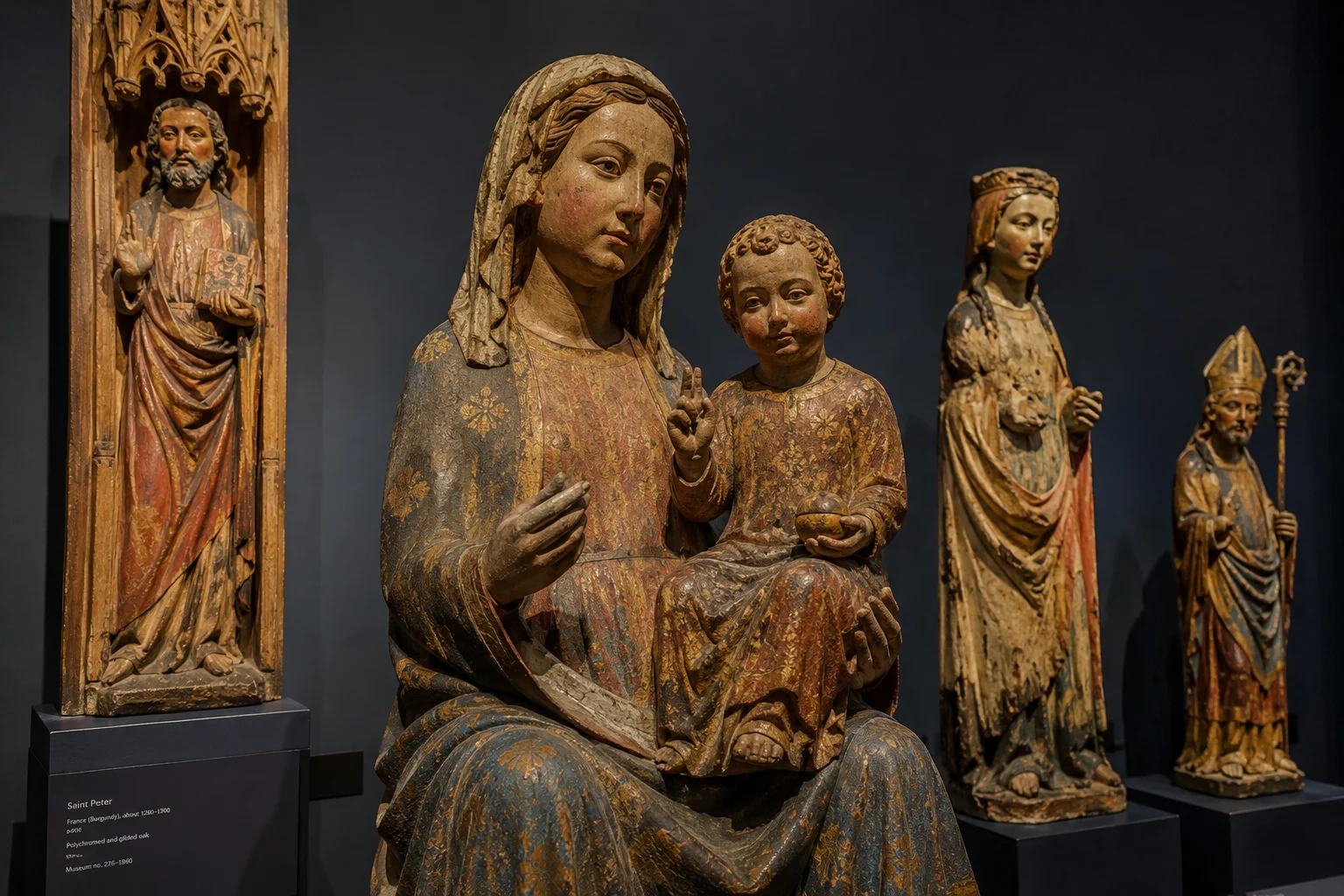
Particularly remarkable are the museum’s wooden religious sculptures from the thirteenth to fifteenth centuries, many of which still preserve traces of their original polychromy. These surviving layers of colour remind us that medieval sculpture was never intended to appear as bare stone or wood, but as vividly painted sacred imagery. Together, the collection offers a rare insight into the craftsmanship, devotional life, and visual culture of medieval Europe.
Italian Renaissance Sculpture
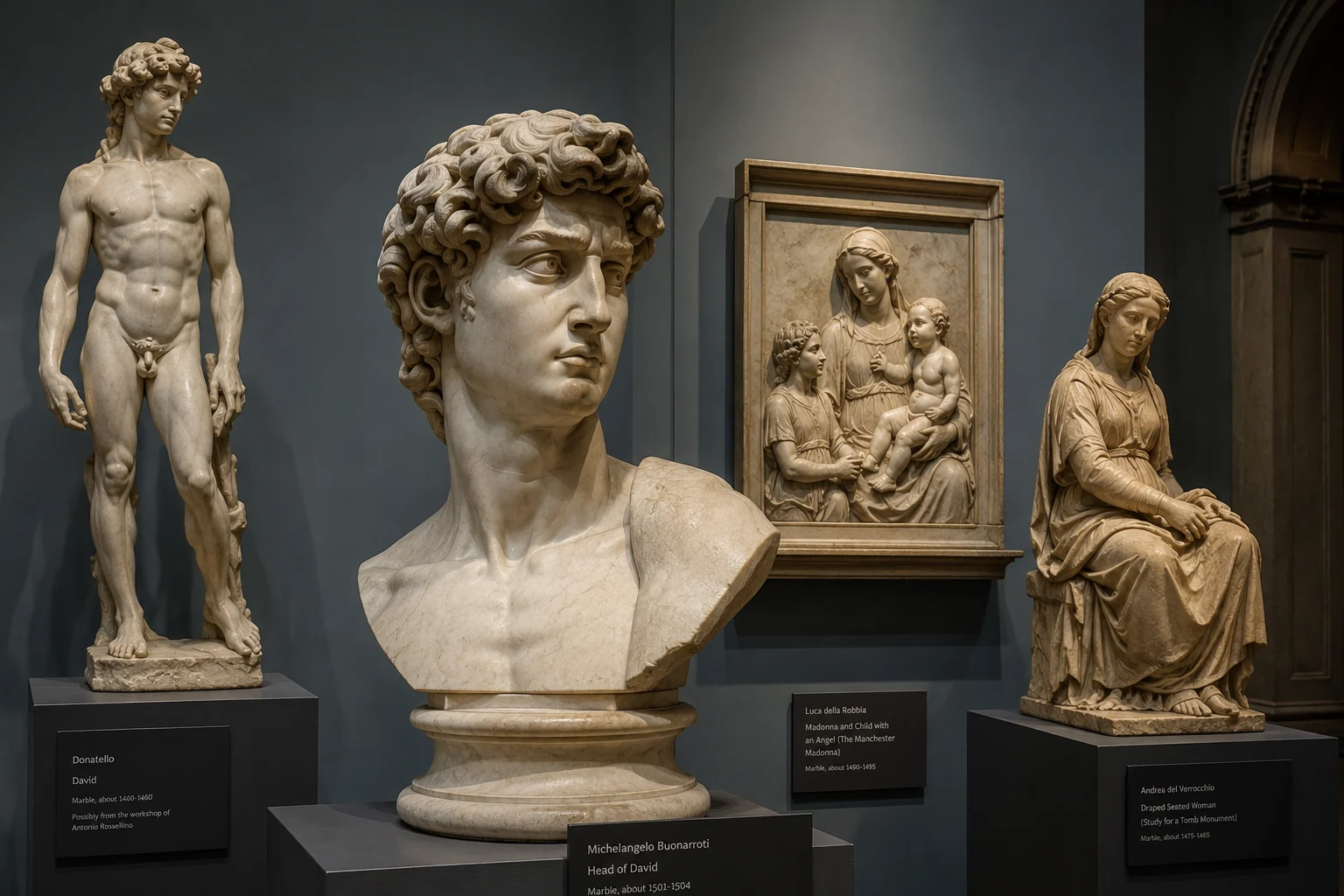
Works by Donatello, Giambologna, and their contemporaries trace the evolution of the human figure in European art during the Renaissance.
The collection illustrates how Renaissance sculptors revived the ideals of classical antiquity while developing a new understanding of anatomy, movement, and emotional expression. From Donatello’s pioneering naturalism to Giambologna’s elegant, dynamic compositions, these masterpieces reveal how sculpture became one of the defining artistic achievements of Renaissance Italy.
Theatre & Performance Collection
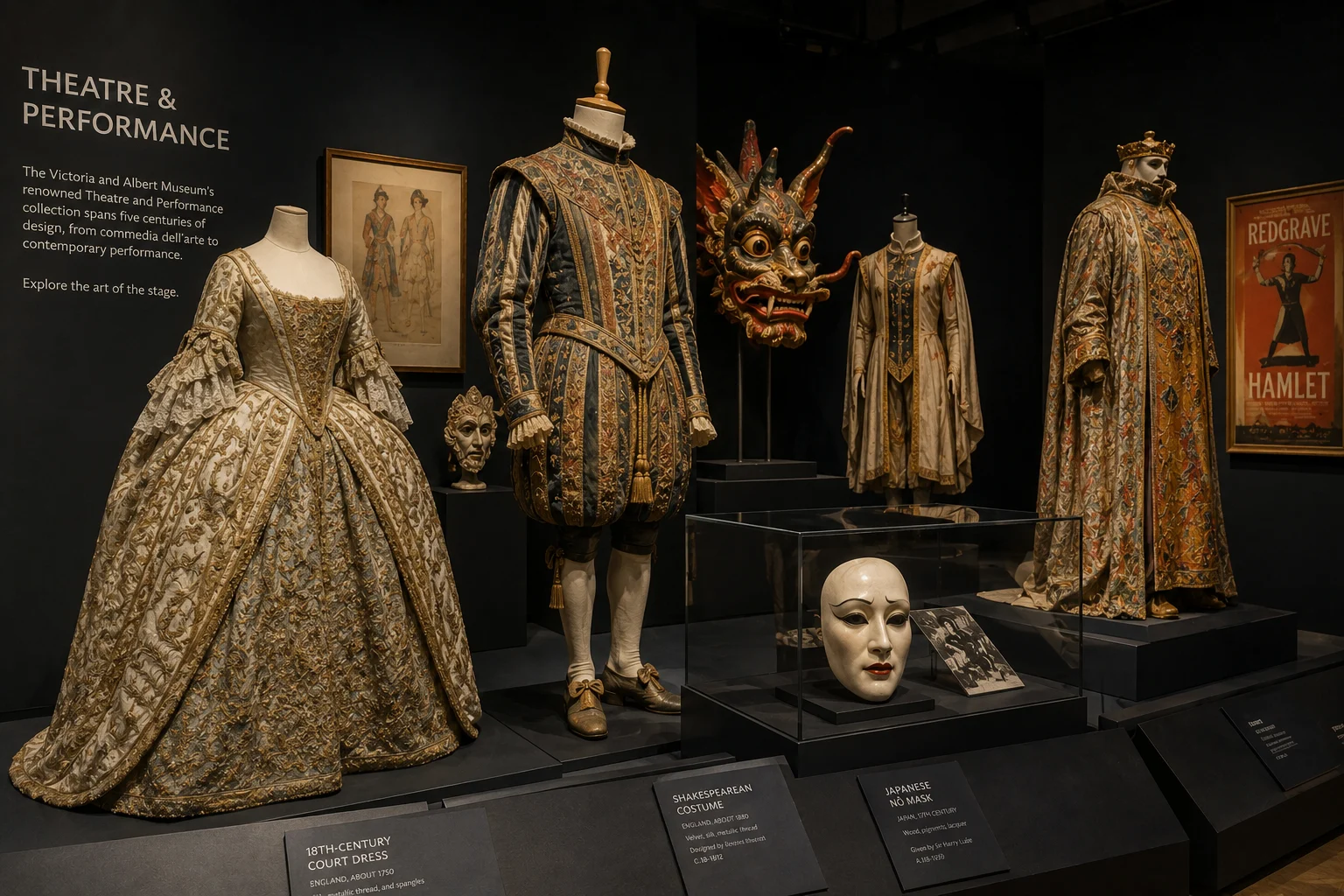
One of the largest theatre collections in the world.
The V&A preserves an extraordinary archive of stage costumes, set and costume designs, playbills, photographs, manuscripts, and the history of British theatre, opera, ballet, and performance. Rather than simply documenting productions, the collection reveals how stage design, costume, and performance have shaped the visual culture of Britain for centuries. For admirers of Shakespeare, it is every bit as essential a destination as many theatres and specialist performance museums.
Why the V&A Changed the History of Art
The Victoria and Albert Museum was one of the first museums to ask a question that remains just as relevant today:
Can beauty change society?
For Victorian Britain, the answer was clear.
A well-designed object could cultivate taste. Good design could improve everyday life. Beauty was not seen as a luxury, but as a force capable of shaping culture. That is why the V&A was created not only for collectors, but also for artists, architects, designers, students, and craftsmen.
Today, design schools around the world continue to use the museum’s collections as an essential educational resource.
When people think of art, they often think first of paintings.
Yet it is the objects we encounter every day—our furniture, clothing, books, ceramics, and interiors—that shape our sense of beauty most profoundly.
The V&A reminds us that art does not exist apart from life.
Culture is expressed not only in masterpieces hanging on museum walls, but also in the way we design the world around us.
During the Second World War, many of the museum’s collections were evacuated for safekeeping, while the building itself continued to serve as an educational institution. In the post-war years, the V&A played a significant role in the revival of British design, helping to shape the country’s international reputation for creativity and innovation.
Helios Recommends
Before your visit, consider exploring:
- John Ruskin — The Seven Lamps of Architecture;
- William Morris — Useful Work versus Useless Toil (and his other essays on art and craftsmanship);
- Penelope Curtis — Sculpture 1900–1945;
- The BBC documentary series The Genius of Design;
- The documentary The Story of British Design.
Wallace Collection
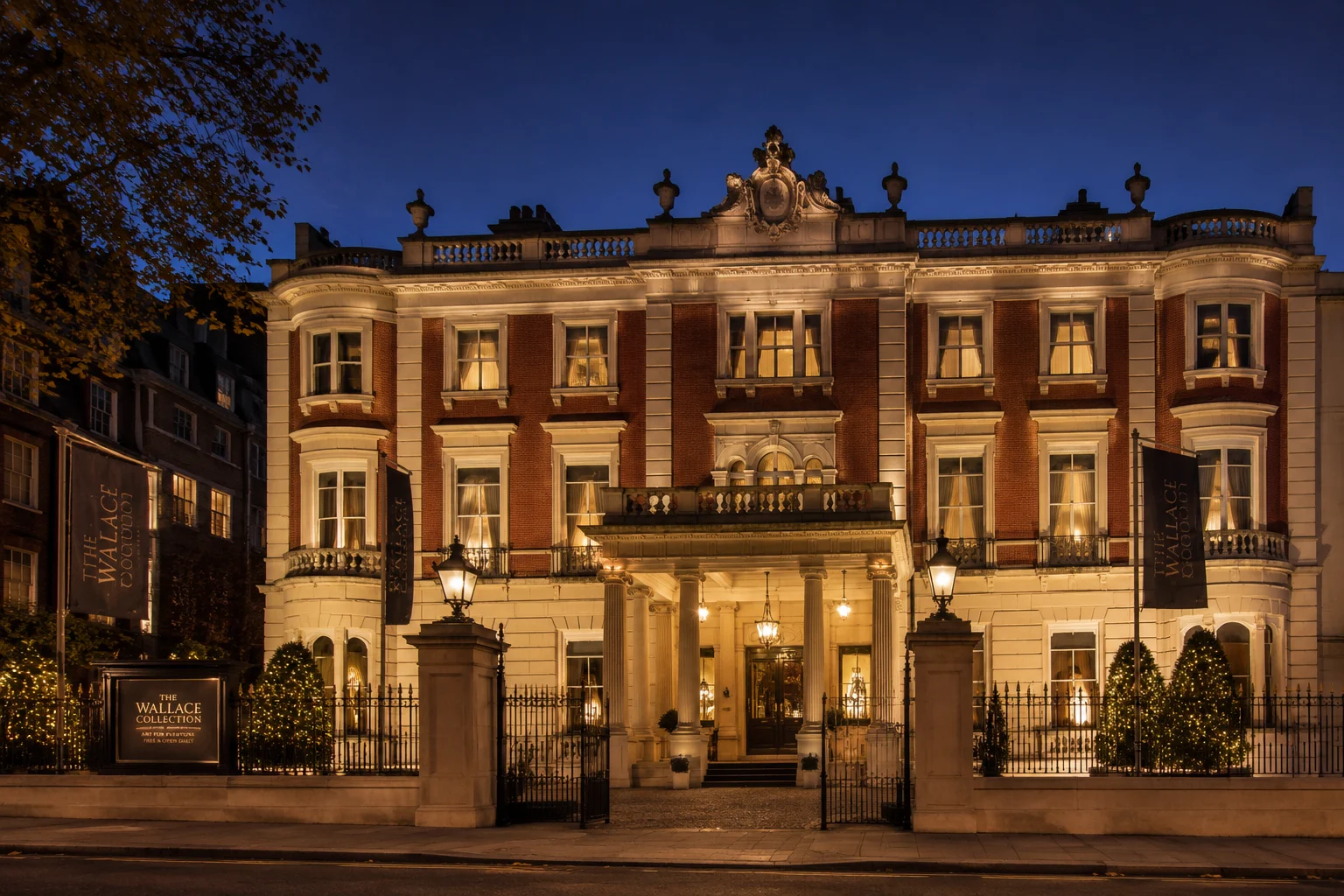
Wallace Collection
🌐 https://www.wallacecollection.org
Hertford House, Manchester Square, London W1U 3BN, United Kingdom
While most art museums aim to tell the story of art, the Wallace Collection tells the story of collecting.
The story of a person who chose to live surrounded by great works of art.
The museum occupies Hertford House, a historic townhouse on the quiet Manchester Square, just a few minutes’ walk from the bustle of Oxford Street.
Behind its understated façade lies one of Europe’s finest private art collections.
Unlike the British Museum or the National Gallery, the Wallace Collection was never conceived as a public institution.
Its holdings were assembled over nearly a century by several generations of the Marquesses of Hertford and later enriched by Sir Richard Wallace.
Old Master paintings, eighteenth-century French furniture, Sèvres porcelain, clocks, arms and armour, and decorative arts were acquired not according to a museum plan, but through personal taste, curiosity, and a passion for collecting.
That is precisely what gives the museum its unique character.
It is not an encyclopaedia of art.
It is a portrait of a collector.
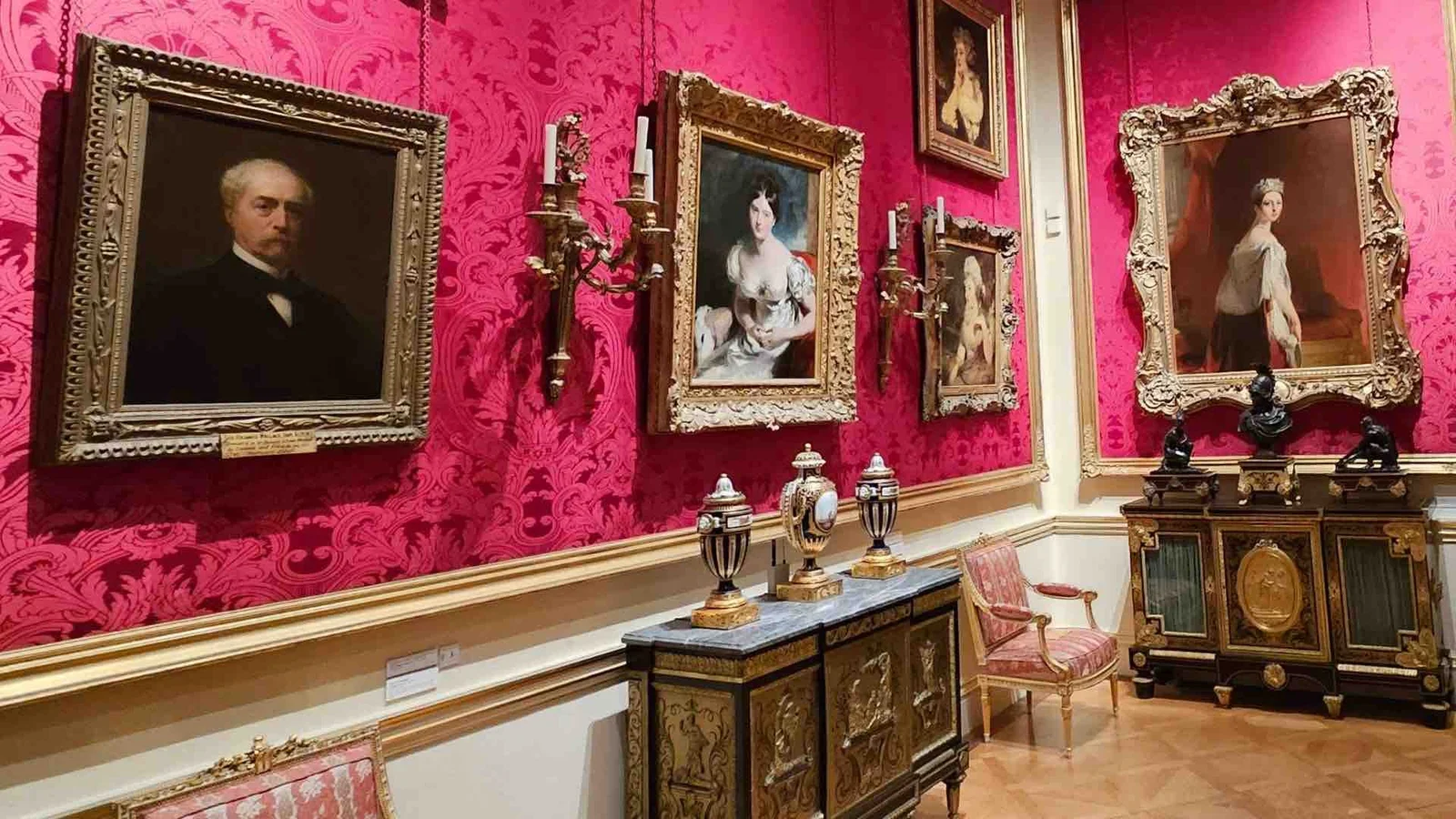
The rooms of the Wallace Collection have preserved the atmosphere of a nineteenth-century aristocratic residence, where paintings, furniture, and decorative objects remain part of a lived interior rather than isolated museum exhibits.
It is easy to forget that you are in a museum.
Instead, you feel as though you have been invited into a magnificent London home whose owner simply wanted to live surrounded by the finest art of his age.
Admission: Entry to the permanent collection is free. Temporary exhibitions may require a separate ticket, and advance booking is recommended for the museum’s most popular exhibitions.
Architecture
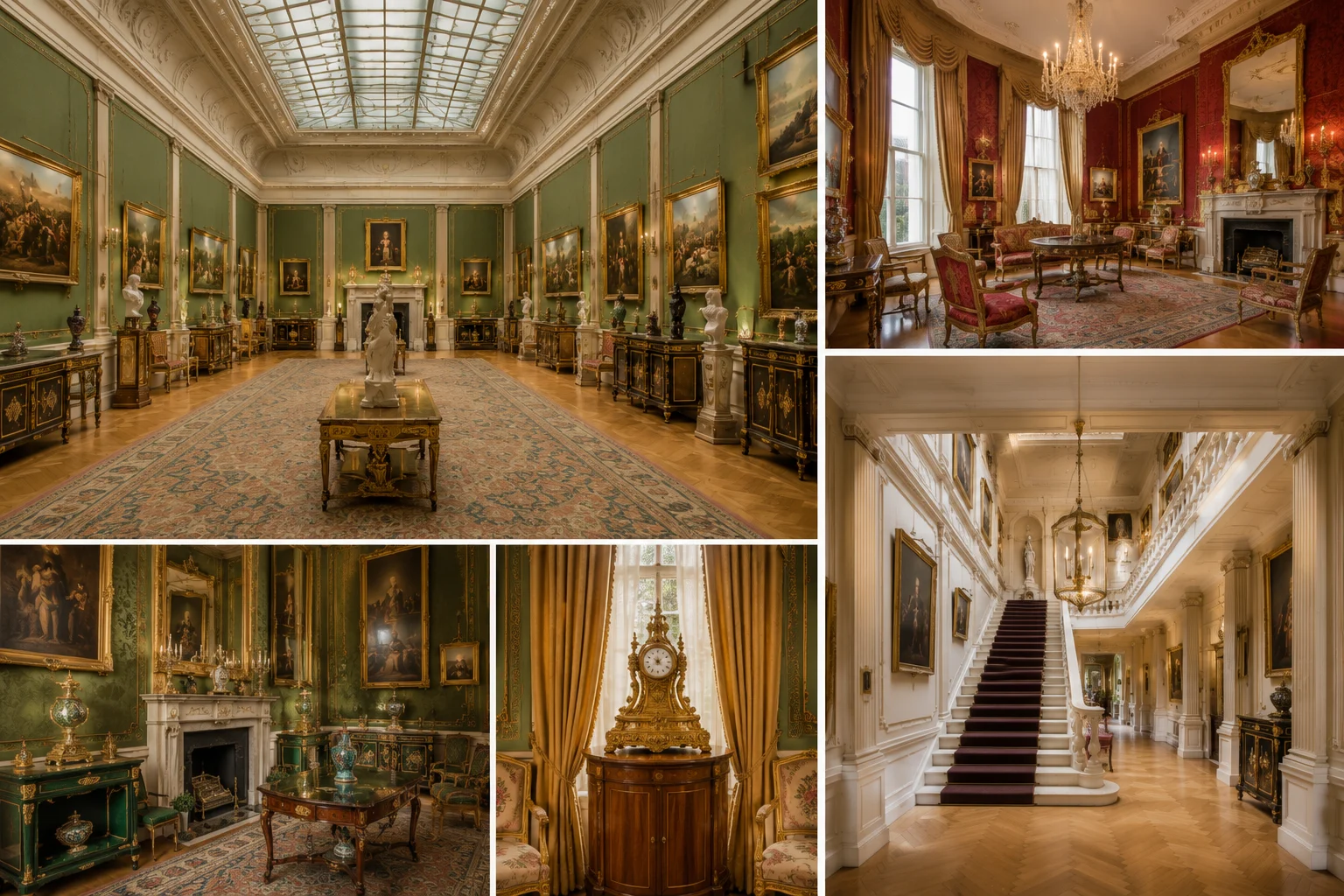
The collection is housed in Hertford House, an eighteenth-century mansion that was remodelled in the nineteenth century for the Hertford family.
Its grand reception rooms, high ceilings, ornate plasterwork, parquet floors, gilded mirrors, silk-covered walls, marble fireplaces, and abundant natural light recreate the atmosphere of a distinguished London townhouse.
This domestic setting is what makes the Wallace Collection unlike almost any other museum.
The paintings do not feel like isolated museum exhibits.
Instead, they remain part of the interiors for which many of them were originally intended, allowing visitors to experience art as it would once have been seen in a private home.
What You Shouldn’t Miss
The Swing — Jean-Honoré Fragonard
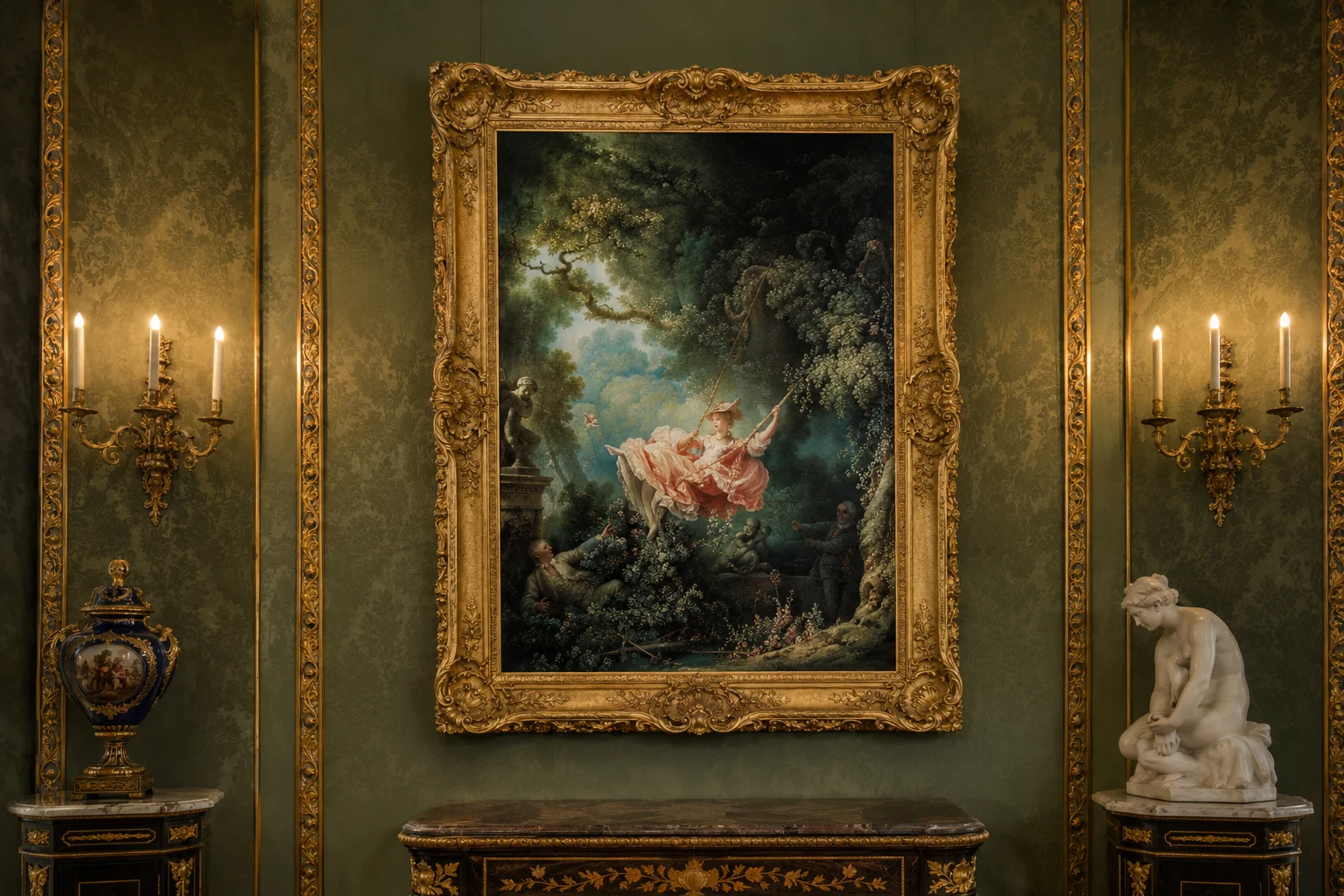
Without exaggeration, one of the most celebrated masterpieces of French Rococo.
At first glance, it appears to be a light-hearted scene of a young woman enjoying a swing in a lush garden. Yet beneath its playful elegance lies a sophisticated world of aristocratic flirtation, hidden symbolism, and theatrical wit. Commissioned around 1767, the painting embodies the refined, pleasure-loving culture of the French court on the eve of the Revolution.
Its luminous palette, graceful movement, billowing fabrics, and effortless composition have made “The Swing” an enduring symbol of the eighteenth century and one of the defining masterpieces of the Rococo style.
The Laughing Cavalier — Frans Hals
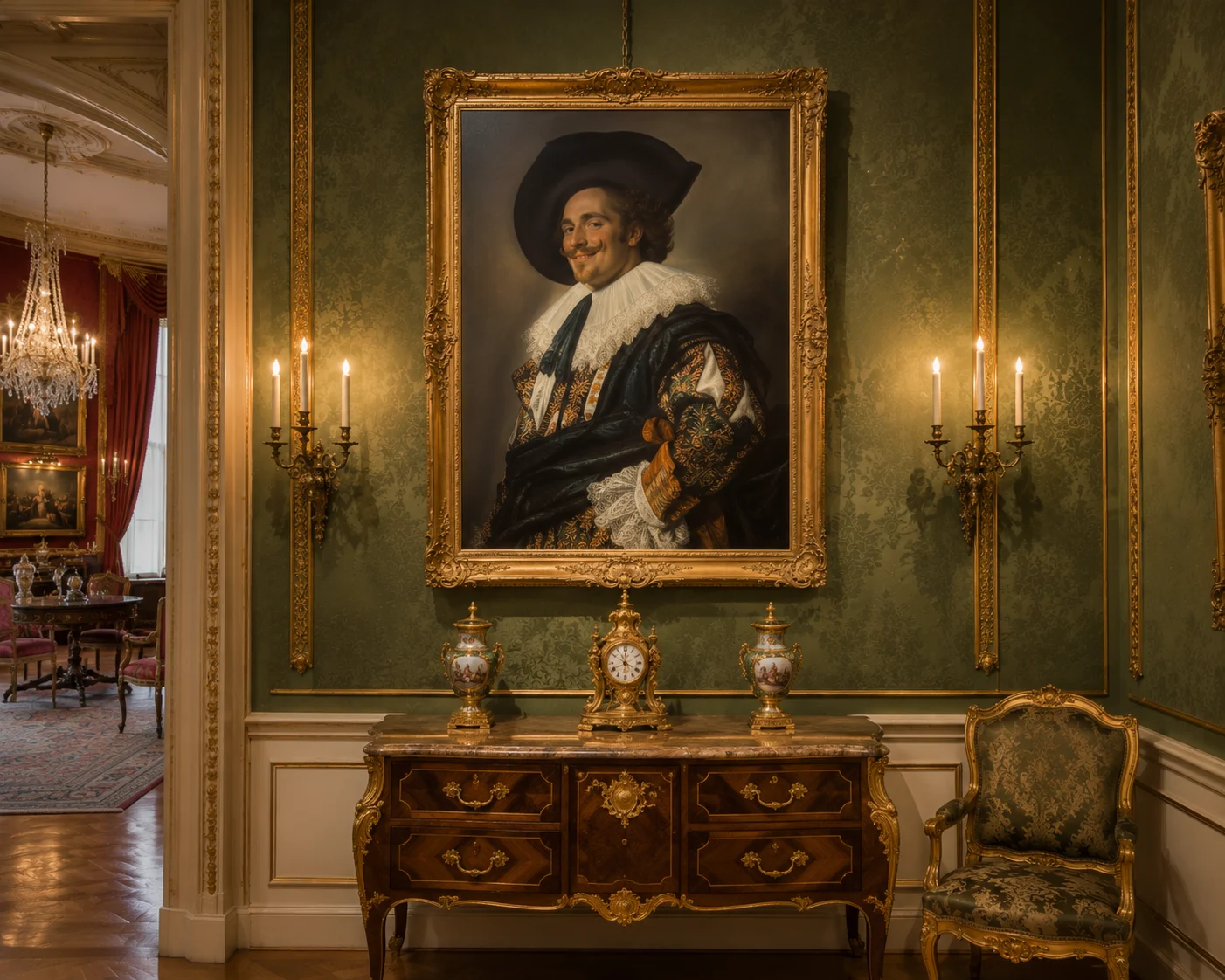
Despite its title, the cavalier is not actually laughing.
His confident gaze and subtle smile have made this portrait one of the most recognisable masterpieces of Dutch Golden Age painting. Created in 1624, the work is celebrated for Frans Hals’s astonishing virtuosity in depicting lace, velvet, silk, and richly embroidered fabrics with seemingly effortless brushwork. The portrait captures not only the sitter’s appearance but also his remarkable sense of presence and individuality.
Collection of Eighteenth-Century French Furniture
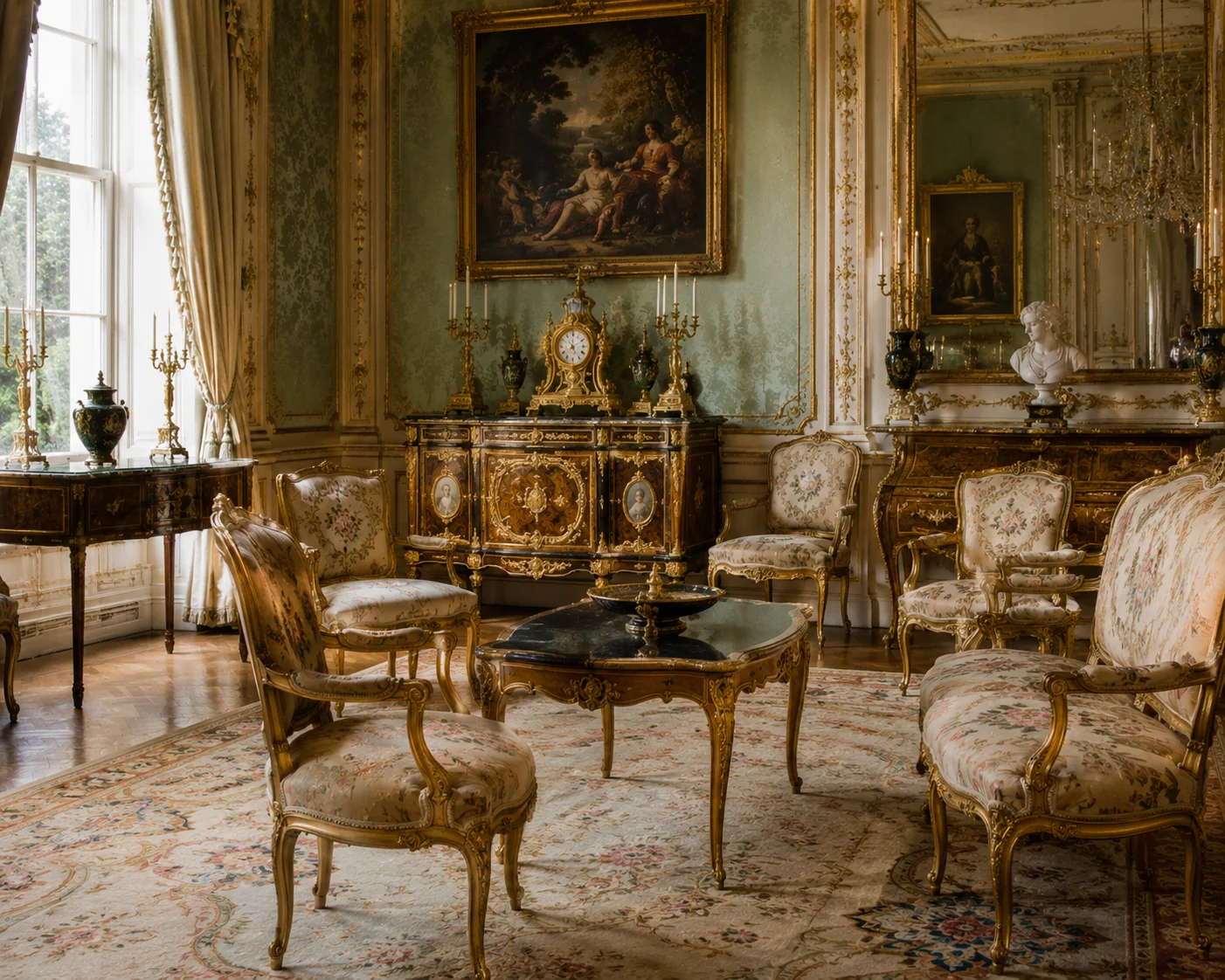
The Wallace Collection is home to one of the finest collections of Louis XV and Louis XVI furniture outside France.
Masterpieces by André-Charles Boulle, Jean-Henri Riesener, and other celebrated cabinetmakers demonstrate how furniture evolved beyond craftsmanship to become a true art form. Exquisite marquetry, gilded bronze mounts, rare woods, and elegant proportions reflect the extraordinary refinement of eighteenth-century French decorative arts, where every piece was designed to combine beauty, function, and prestige.
European Arms and Armour
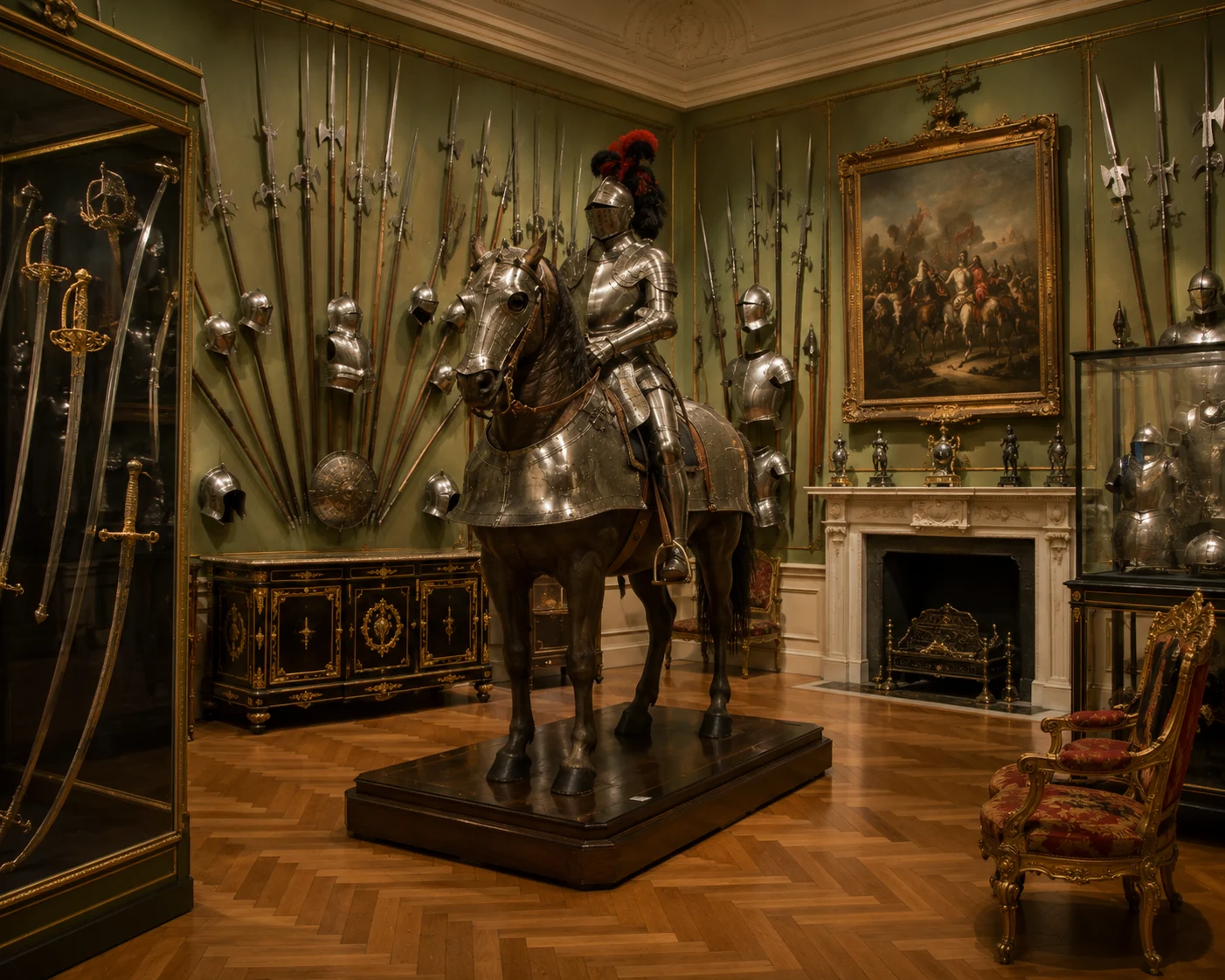
For many visitors, this collection comes as a surprise.
The Wallace Collection houses one of Europe’s most impressive collections of arms and armour, ranging from medieval swords to richly decorated Renaissance parade armour. Particularly remarkable are the ceremonial suits adorned with gold, silver, and intricate engraving. These masterpieces were created not only for the battlefield but also as symbols of status, political power, and exceptional artistic craftsmanship
Sèvres Porcelain
The royal Sèvres Porcelain Manufactory became one of the defining symbols of luxury in eighteenth-century Europe.
The Wallace Collection’s outstanding holdings trace the transformation of porcelain from a rare Eastern import into one of the most prized artistic achievements of European decorative arts. With its exquisite craftsmanship, vibrant colours, gilded decoration, and refined forms, Sèvres porcelain embodied the elegance and sophistication of the French court and set the standard for luxury across Europe.
Seventeenth-Century Dutch Painting
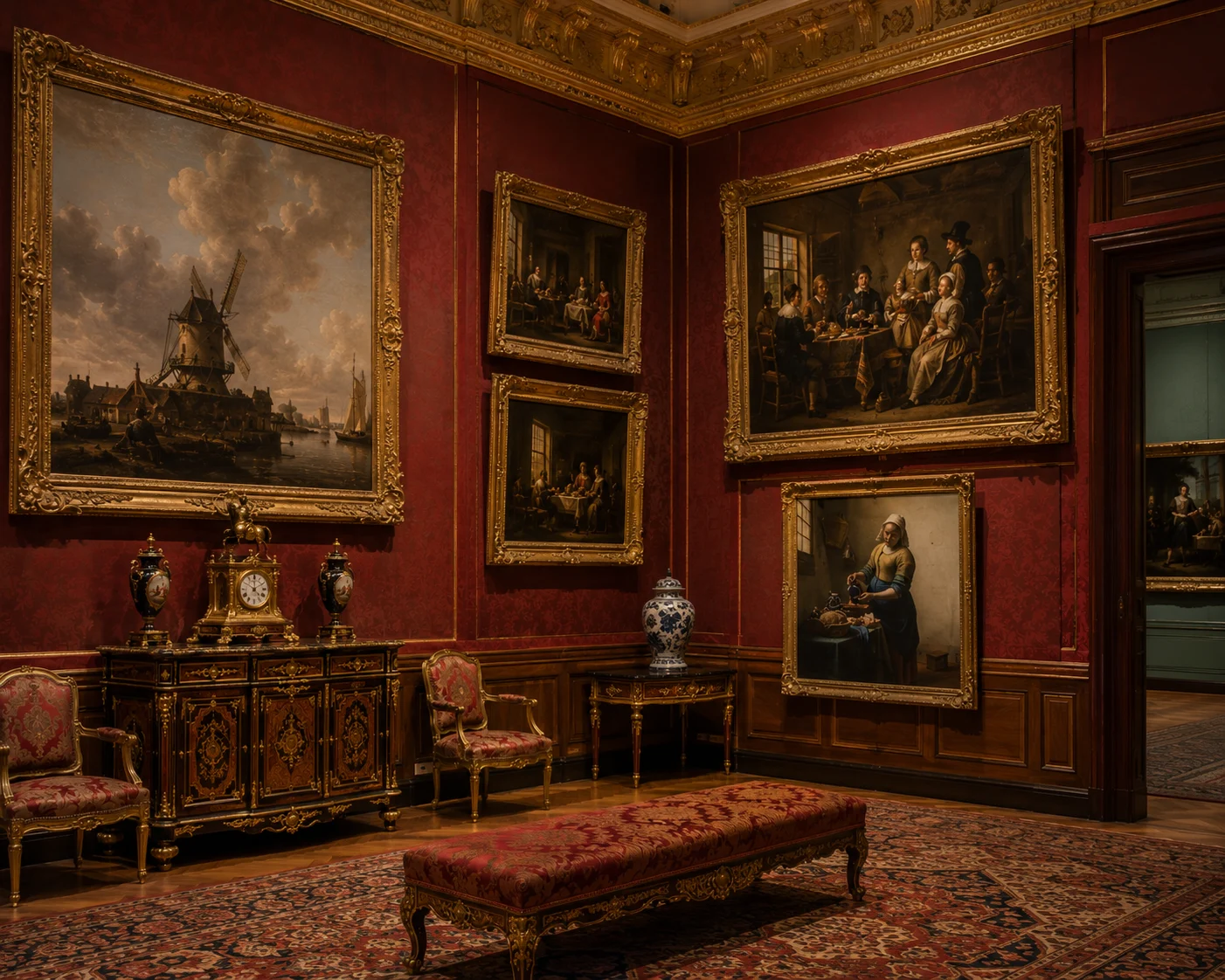
Works by Rembrandt, Gerard ter Borch, Adriaen van Ostade, and other Dutch masters make the Wallace Collection an essential destination for admirers of the Dutch Golden Age.
These paintings capture the richness of everyday life with extraordinary psychological insight and technical brilliance. Whether portraying intimate domestic interiors, portraits, or scenes of ordinary people, they demonstrate how seventeenth-century Dutch artists transformed the observation of daily life into one of the greatest achievements of European painting.
Why the Wallace Collection Is Unique
Most museums tell the story of art. The Wallace Collection tells the story of taste.
What makes it exceptional is not only the quality of its masterpieces but also the setting in which they are displayed. The museum preserves the atmosphere of a grand private residence, revealing how paintings, furniture, porcelain, clocks, arms, and decorative objects once formed part of everyday aristocratic life rather than existing as isolated museum pieces.
The collection also challenges a common assumption about collecting. We often think of collectors as owners of great works of art. The Wallace Collection suggests something different: the greatest collectors are merely temporary custodians of beauty, preserving it for future generations. This is why the finest private collections eventually become part of the public realm.
Above all, the Wallace Collection reminds us that beauty is not confined to universally recognised masterpieces. It can be found in the curve of a chair, the craftsmanship of a bronze handle, the pattern of a parquet floor, or the way natural light falls across a gilded frame. It is a museum that teaches visitors not simply to admire great art, but to appreciate the culture of everyday objects.
Sir Richard Wallace bequeathed the entire collection to the British nation on one condition: it could never be divided or sold. Thanks to this remarkable gift, the museum retains the character and integrity it possessed during his lifetime.
Helios Recommends
Books
- Philip Mansel — Paris Between Empires
- Norbert Elias — The Civilizing Process
Film
- Barry Lyndon (dir. Stanley Kubrick)
Few films capture the elegance, atmosphere, and visual culture of eighteenth-century Europe as beautifully as Kubrick’s masterpiece.
London as a Museum City
The true strength of London’s museum landscape lies not only in the exceptional quality of its collections, but in the different ways its institutions interpret art, history, and culture.
The British Museum tells the story of civilisation through archaeology and material culture. The National Gallery traces the evolution of European painting from the Middle Ages to the dawn of modernity. The Victoria and Albert Museum expands the definition of art to include design, craftsmanship, fashion, architecture, and the objects of everyday life. The Wallace Collection, meanwhile, preserves the perspective of a private collector, where paintings, furniture, porcelain, and armour continue to exist within the setting of a historic home.
Together, these museums demonstrate that a museum is never simply a repository of remarkable objects. Every institution constructs a particular vision of the past, selecting, interpreting, and connecting works in ways that shape how visitors understand history.
The story of London’s museums therefore extends far beyond aesthetics. Their collections are inseparable from archaeology, diplomacy, collecting, imperial history, and ongoing debates surrounding provenance, restitution, and cultural ownership. These questions do not diminish the importance of the collections; rather, they deepen our understanding of them.
Ultimately, London’s museums invite us to look beyond individual masterpieces and to see culture as an interconnected whole. They remind us that the value of a museum lies not in the number of galleries we visit, but in the quality of attention we bring to what we see.
That is why London remains one of the world’s great artistic capitals—not because it possesses extraordinary collections alone, but because it offers so many different ways of understanding civilisation through art.
Coming in Part II
This guide is only the first chapter of London’s extraordinary museum landscape.
In Part II, we will explore another side of the city’s cultural life: Tate Britain, the Courtauld Gallery, Sir John Soane’s Museum, Dulwich Picture Gallery, university museums, historic house museums, and other remarkable collections that rarely appear in standard tourist itineraries.
Together, they reveal that London’s artistic identity cannot be understood through a single museum or a single narrative.
Like the city itself, it is a rich and layered story—one best discovered slowly, one museum at a time.