



The Art of Becoming: Philosophy and Personal Development
An exploration of how ancient philosophy can help us consciously shape our character and lives. Socratic questioning, Stoicism, Aristotelian ethics, and intellectual dialogue become practical tools for personal development.
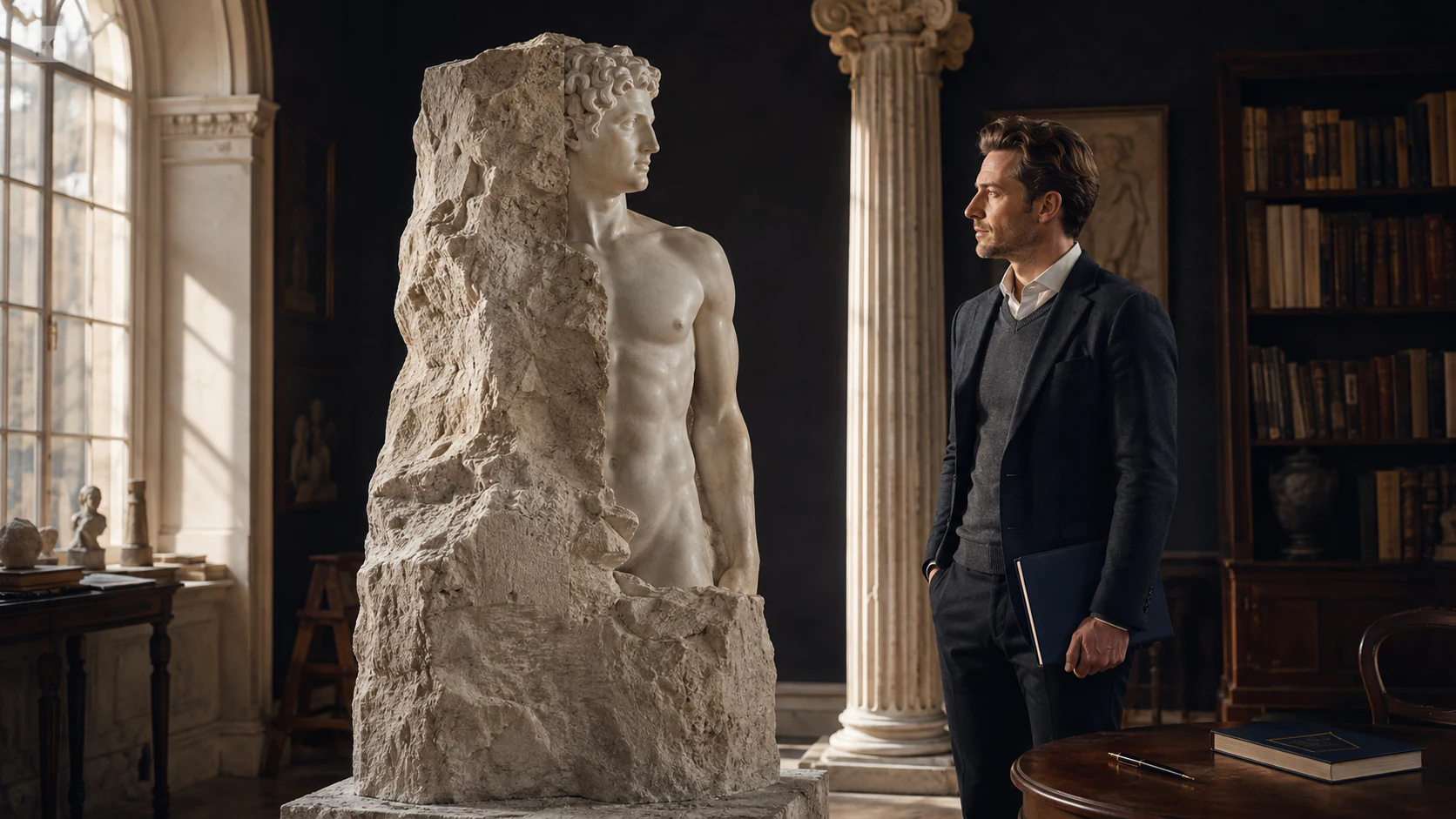
The art of becoming: philosophy and personal development
"The unexamined life is not worth living." Socrates delivered this verdict at his own trial, knowing that the sentence he faced for living philosophically was death. Many students first read this line in an introductory course and move on. They ought not to. It is not a rhetorical flourish. It is a provocation, a demand that each of us account for the values we hold, the assumptions we carry unquestioned, and the gap between who we are and who we intend to become. That demand is, in essence, the connection between philosophy and personal development: both disciplines insist that an unexamined life is a life only half-lived.
For most educated people today, philosophy remains a spectator discipline: something studied, critiqued, and set aside. Yet it began not in the lecture hall but in the marketplace, the garden, and the colonnade. For Plato, Epictetus, and Marcus Aurelius alike, philosophy was not a body of knowledge to be acquired but a set of practices to be lived. The relationship between philosophy and personal development is therefore not a modern invention; it is a restoration of something ancient that we allowed to fall away. At Helios Intellectual Club in London, that restoration is precisely what is underway: a community where philosophy is practised through curated dialogue, genuine encounter, and the shared seriousness of the examined life.
Philosophy was never meant to be a spectator sport
The philosopher Pierre Hadot spent much of his scholarly life making a single, uncomfortable argument: that ancient philosophy was not primarily theoretical but a collection of what he called "spiritual exercises", practices of attention, self-examination, and conscious living. For the Platonists, Stoics, and Epicureans, joining a philosophical school involved committing to a distinctive way of life and a set of practices that reshaped how one thought, acted, and related to others. You adopted a way of seeing, a discipline of thought, and a commitment to living differently as a result.
This understanding was gradually lost as philosophy migrated into the university. Somewhere between Aristotle's Lyceum and the modern seminar room, the subject became an object: something to analyse rather than a method for transformation. As scholars such as Hadot have observed, one consequence of this shift is that academic philosophy can become preoccupied with reconstructing the history of moral theory while neglecting the more personal question of how one ought to live. The gap between knowing and becoming is exactly where personal development collapses. Closing that gap requires returning to philosophy in its original sense: as the art of living well.
What connects philosophy and personal development: Socratic self-examination
Socrates claimed to know nothing. This was not false modesty. It was the engine of his entire method. By refusing to accept comfortable answers, he forced his interlocutors to examine the architecture of their own beliefs, and almost invariably, the architecture did not hold. What looked like certainty turned out to be habit. What felt like conviction turned out to be inheritance.
The Socratic method, properly understood, is not a debating technique. It is a practice of disciplined self-examination, and it applies directly to the decisions we navigate every day. The choices we make poorly are rarely the result of insufficient information; they are usually the consequence of unexamined assumptions. When someone faces a significant decision about their work, a relationship, or a core value, the Socratic approach begins with a single disarming question: "What am I taking for granted?" It then moves through "What evidence actually supports this?" and arrives, often uncomfortably, at "What would I have to rethink if I held a different view?"
This is philosophical counselling in its most portable form. No therapist's couch is required. What is required is the willingness to sit with an honest answer, even when it disturbs something you had settled. The person who genuinely practises this, over months and years, develops a quality of mind that is rarer than intelligence: the capacity to be changed by what inquiry reveals. It is an authorial judgement, admittedly, but one well supported by the long tradition of Socratic questioning for self-knowledge that runs from Athens to contemporary reflective practice.
Stoicism and personal development: governing what is yours to govern
Marcus Aurelius wrote his Meditations entirely for himself. He never intended them for publication. They were a private discipline, a daily effort to remember a single principle: distinguish what is within your power from what is not, and invest your energy accordingly. This Stoic dichotomy of control has been widely influential in practical philosophy and self-help traditions alike, and for good reason. When you stop spending energy on what you cannot govern, you have far more to invest where it counts.
Seneca, writing to his friend Lucilius across dozens of letters, counselled something even more counterintuitive: rehearse loss before it arrives. The practice known as premeditatio malorum, the premeditation of adversity, asks you to imagine clearly a setback, a failure, a reversal of fortune. Not to invite despair, but to drain the event of its power to devastate you when it comes. Acceptance-based approaches to psychology suggest that this ancient instinct has some support: rehearsing and mentally accepting difficulty may reduce its psychological grip, though the evidence for Stoic-style exercises specifically remains preliminary and largely indirect. The exercise itself is brief. Spend five minutes each morning imagining one thing that could go wrong in your day. Observe the response in your body. Then decide, deliberately, how you would meet it. What returns is not fearlessness but something more useful: readiness.
Stoicism and personal development share a core conviction: that the quality of a life depends less on what happens to us than on the orientation we bring to it. This is philosophy applied not as consolation but as preparation.
Aristotle and the philosophy of who you are becoming
Aristotle's Nicomachean Ethics opens not with a definition of virtue but with an observation about desire: everything we do, we do for the sake of some good. The question he spends the rest of the book answering is which good is worth organising a life around. His answer is eudaimonia: flourishing, sometimes translated as happiness, though the word is richer than either English equivalent suggests. And his method for reaching it is not inspiration. It is habit.
Character, for Aristotle, is not a given. It is cultivated. We become courageous by doing courageous things, patient by practising patience, honest by refusing, again and again, the small evasions that accumulate into self-deception. This doctrine of habituation underpins a practice worth adopting immediately: the virtues journal. Each evening, choose one virtue you intended to cultivate that day. Record a single moment when it was tested. Note what you did, what you felt, and what you would do differently. Over weeks, patterns emerge that are invisible in the moment but unmistakable across time. This is philosophy applied not as a system of thought but as a mirror held up to character.
Building a life philosophy framework for personal development
A personal philosophy is not a mission statement and it is not a motivational mantra. It is a coherent structure of values, beliefs, and principles, the kind of life philosophy framework that guides decisions precisely when the stakes are high and the situation is unclear. This values-to-principles model is well established in both philosophical and coaching traditions. Building one requires moving through three levels, each more specific than the last.
Begin with values: what genuinely matters to you, not what you believe ought to matter. Then move to beliefs: what you hold to be true about people, meaning, and the world. Finally, translate these into principles, the rules by which you will act when no rule seems to apply. The core prompts are deceptively simple.
- "What do I value, and how do I know I value it rather than merely approving of it?"
- "What do I believe about how people change, what makes a life meaningful, and what I owe others?"
- "What principles follow from these beliefs, and how would I act if I lived by them consistently?"
- "Where did my current choices diverge from this, and what does that divergence reveal?"
The final question is the most important. A values list that has never been tested against a real decision is merely a list of aspirations. Take a difficult choice you made recently. Trace whether your actions reflected the values you profess, or quietly contradicted them. Where they diverged, something important is revealed: not a failure to be condemned, but a gap to be understood. This values clarification exercise is one of the most direct points of contact between philosophy and self-improvement. Genuine self-mastery begins not in grand declarations but in the honest encounter with inconsistency.
Philosophy lived in dialogue: where theory becomes transformation
There is a limit to what philosophical self-examination can achieve in solitude. Socrates did not examine himself alone; he examined himself in conversation, which is precisely why his influence was so transformative for those who gathered around him. The history of intellectual growth is, in large part, a history of ideas tested and refined through genuine dialogue: from the Athenian agora to the Parisian literary salons of the seventeenth century, from the Vienna Circle to the great intellectual communities that gathered around shared questions rather than shared credentials. When a belief is spoken aloud and met with a thoughtful challenge, it either deepens or dissolves. Both outcomes are forms of growth.
This is the tradition that Helios Intellectual Club was founded to revive in contemporary London. Unlike a lecture series or an online course, Helios creates the conditions in which philosophy can be practised as it was originally intended: through curated dialogue, collaborative inquiry, and genuine intellectual encounter among thinkers who bring their real questions about meaning, values, and decision-making into the room. Members do not simply study Stoicism or Aristotelian ethics as historical curiosities; they are invited to bring these frameworks into contact with the actual texture of their lives, their choices, and the questions that do not resolve themselves before dawn.
Conclusion: the examined life as a lifelong practice
Socrates did not commend the examined life because it was comfortable. He commended it knowing that examination demands courage, honesty, and the willingness to be changed by what inquiry reveals. The connection between philosophy and personal development is most visible here: both disciplines require you to look at who you are and ask, with genuine seriousness, whether you are who you intend to become.
The practices gathered in this essay, Socratic questioning, Stoic preparation, Aristotelian habituation, values clarification, are not destinations. They are entry points into a practice that does not conclude. No single exercise will produce self-mastery, any more than a single conversation produces wisdom. What they offer is orientation: a way of turning toward the questions that matter rather than away from them. Together, they constitute a philosophy-based approach to wellbeingthat is as practical as it is ancient.
The examined life is almost always better undertaken in the company of others who share the seriousness of the inquiry. If you are ready to begin, or to go deeper, Helios Intellectual Club is one of those rare places in London where that company exists. Get in touch to learn more about membership and the dialogues currently open for application.
FAQ: philosophy and personal development
What is the connection between philosophy and personal development?
Philosophy and personal development share the same fundamental aim: to help us live more intentionally, more honestly, and more fully. Ancient philosophical schools, Stoic, Platonic, Epicurean, were not primarily academic institutions but communities of practice in which members cultivated specific habits of mind and character. That original understanding frames personal development not as self-improvement through tips and techniques, but as the ongoing project of becoming who one genuinely intends to be, guided by examined values, disciplined reflection, and genuine dialogue with others.